
Will you chip in to support our nonprofit newsroom with a donation today? Yes, I want to support My Lynnwood News!
Several seniors came to the Lynnwood City Council’s Feb. 12 business meeting to express concerns and ask questions during a public hearing about a proposed housing development. At its last work session, the council learned that the Northwest Housing Preservation Group (NWHPG) intended to add 36 additional affordable housing units to its pre-existing housing complex –Garden Senior Village – located at 6425 196th St. S.W.
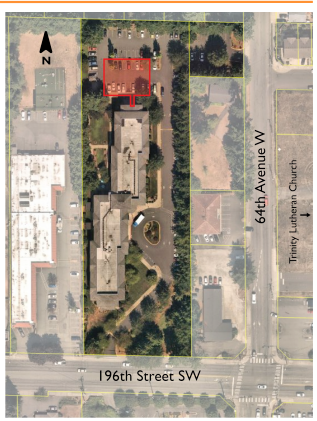
Nonprofit-owned Garden Senior Village currently contains 121 affordable housing units allotted for seniors ages 55 and older. Affordable housing measures that support the complex allow tenants making 50% of Snohomish County median income to occupy units despite their low income. NWHPG initially proposed that newly constructed units would be available at 60% median income, but prior to Monday’s meeting reverted to the lesser 50% benchmark to address council concerns about the difference.
Currently, 70 vehicles are registered for 122 units. Developers say that their plan for new units would remove eight parking stalls – leaving 106 stalls available after construction. That number is below the Lynnwood Municipal Code’s standard parking requirement for senior housing, which requires 1.55 stalls per unit. Industry standards for senior affordable housing recommend a ratio of .44 stalls per unit.
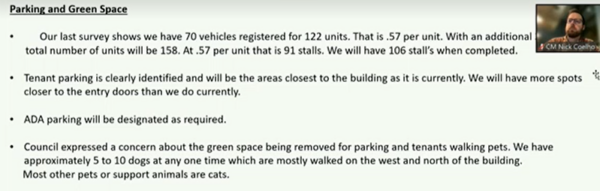
An internal study from the city and an external study by Kimley-Horn and Associates concluded that the facility needs parking more in line with one space per 2 units (.50/unit). The requested design provides a ratio of .664 spaces per unit.
NWHPG also requested exemptions to allow increased building height (41 feet instead of 35) and a greater number of units (158 instead of 134), so a public hearing was held to consider the developer’s request and receive input from the community.
During the public hearing, the most common complaints from senior tenants already living at Garden Senior Village were about parking and temporary displacement or disruption.
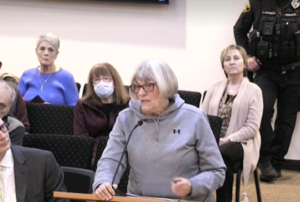
Tenant Arlene Sorensen spoke on behalf of her friends. “Many of the people are in their rooms a lot. There’s some people we don’t see much and this move that’s proposed is really difficult for older people. In order to do the upgrade and repairs for the older building and that’s a real difficulty for an older community. We love living there and we’re grateful for what we have, but we know this is going to be a real big trauma for them,” Sorensen said.

Another tenant, Jeannine Hardin, demanded accountability. Hardin said she doubted management’s trustworthiness, alleging that the complex’s manager violated its rules by keeping an unregistered vehicle in the lot. Further, some vehicles owned by complex employees had expired tabs.
Other concerns included how stable the building would be if it were changed, that the proposed new design would make hallways too long and whether the complex’s gardening space would remain.

NWHPG President Jim Morino answered questions from public commenters and councilmembers. Morino also shared plans detailing the addition of an elevator and two more laundry rooms, along with air conditioning in the new units. The project would not require the removal of any trees.
When asked the duration of construction, Morino responded that it was expected to last approximately one year. Councilmember Patrick Decker asked if tenants could keep their belongings in their units to lessen the hardship of moving back and forth. Morino responded that developers would make an effort to cause as little displacement as possible, but he was unsure whether construction would require temporary relocation to another part of the complex. He added that displacement and disruptions were major considerations for NWHPG, and they could plan around the site by acquiring temporary parking spots near the site. Decker also asked if councilmembers would have any more authority or opportunities to regulate the project if they approved it. Community Planning Manager Karl Almgren informed him that they would not.

Councilmember David Parshall asked Morino if plumbing issues that needed to be fixed would cause displacement. Morino confirmed that the building’s plastic fittings had become brittle and that they and other key components of the plumbing system would need to be replaced even if new units were not added.
A decision on whether developers can proceed with their plans is scheduled for Feb. 26. The council’s options are to approve as-is, approve with stipulations/changes or reject the proposal.
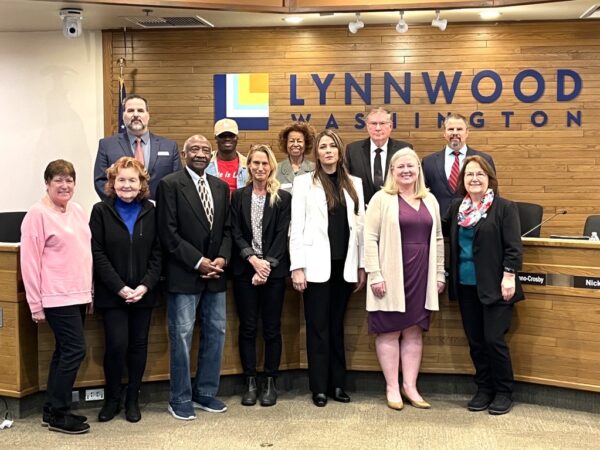

In other business, the council read proclamations honoring former Councilmember Loren Simmonds and acknowledging Black History Month. Simmonds, who died in December, served as a Lynnwood city councilmember from 2000-2015. The proclamation was delayed to February so that his daughter, Wendy, could attend.
The council also unanimously voted to approve an incentivization program that will allow about $45,000 of the Parks, Recreation and Cultural Arts department’s budget to be used for lifeguard and camp counselor bonuses. No additional funds were requested from the city budget. Part-time lifeguards and camp counselors will receive a bonus of $250 for 143 hours per quarter, or $750 if they work 273 hours. The bonus was proposed after staff reported that it was challenging to get young seasonal workers to work enough hours. The bonus is also designed to attract more competitive talent as recreation staff begin to recruit and train summer workers. Should the bonus function as intended, the city can recoup financial costs for the program because more people will be served by the city’s summer pool and camp programs.
Other items addressed at the Monday meeting include:
– A unanimous vote to approve the 2024 Finance Committee meeting calendar
– A unanimous vote to approve a drafted document dictating a change of council rules. The rules require public commenters attending remotely to register to comment 24 hours in advance. Councilmember Patrick Decker had some language corrections that he asked staff to implement when possible.
— By Jasmine Contreras-Lewis


Real first and last names — as well as city of residence — are required for all commenters.
This is so we can verify your identity before approving your comment.
By commenting here you agree to abide by our Code of Conduct. Please read our code at the bottom of this page before commenting.