
Will you chip in to support our nonprofit newsroom with a donation today? Yes, I want to support My Lynnwood News!
This is the second installment of Edmonds resident Nathaniel Brown’s recent travels to Greece. You can read part 1 here.
Patra
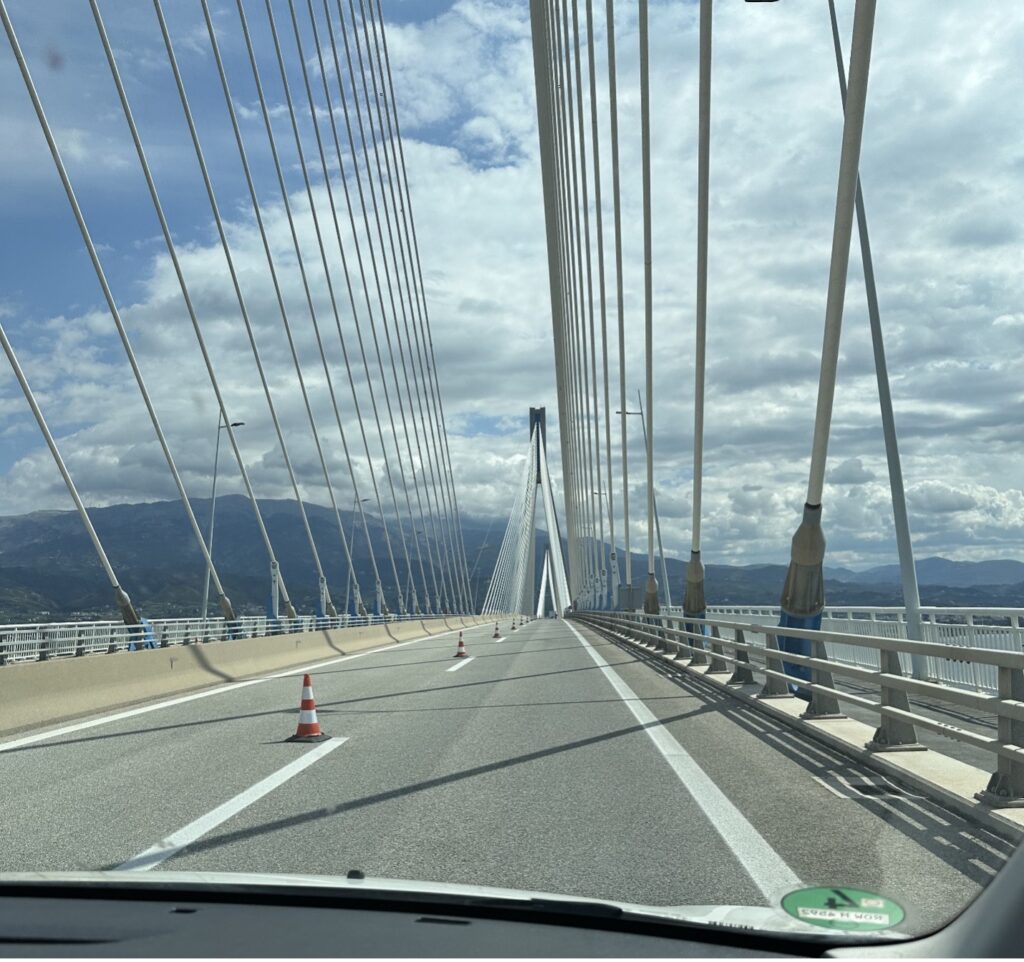
My driver to Patra had never been in the Peloponnese before, and was as excited and interested as I was. The way from Thessaloniki lies along Highway E90 and Highway 5 and crosses over the shoulders of the Pindos National Park and Meteora, and it’s magnificent; the relatively new highway with it almost endless succession of tunnels is an engineering marvel, as are the mountains you pass over or by. The drive ends when you cross the suspension bridge across the Gulph of Patras and onto the Peloponnese.
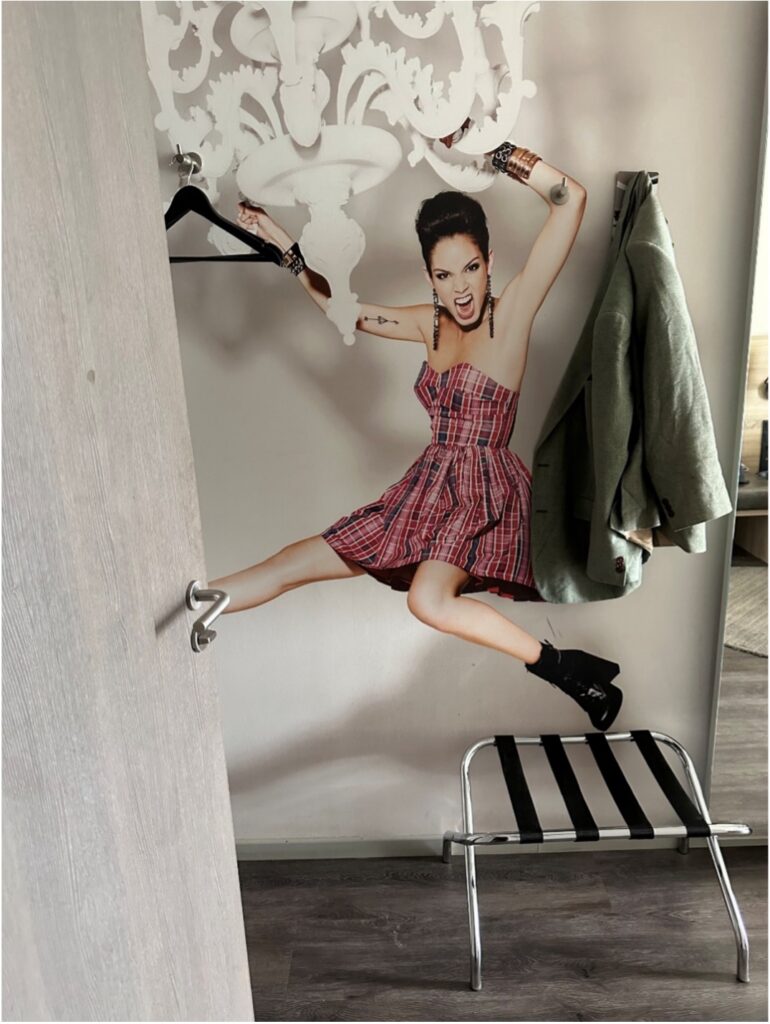
I had reserved a room the Moxy, a curious hotel with a very modern “vibe,” nice rooms and a rooftop bar/restaurant where the views are as wonderful as the service is bad – a sort of help-yourself-we’re-way-too-busy ambiance, which may be part of the youthful “vibe”? The wall poster in my room seemed to capture the whole atmosphere; believe it or not:
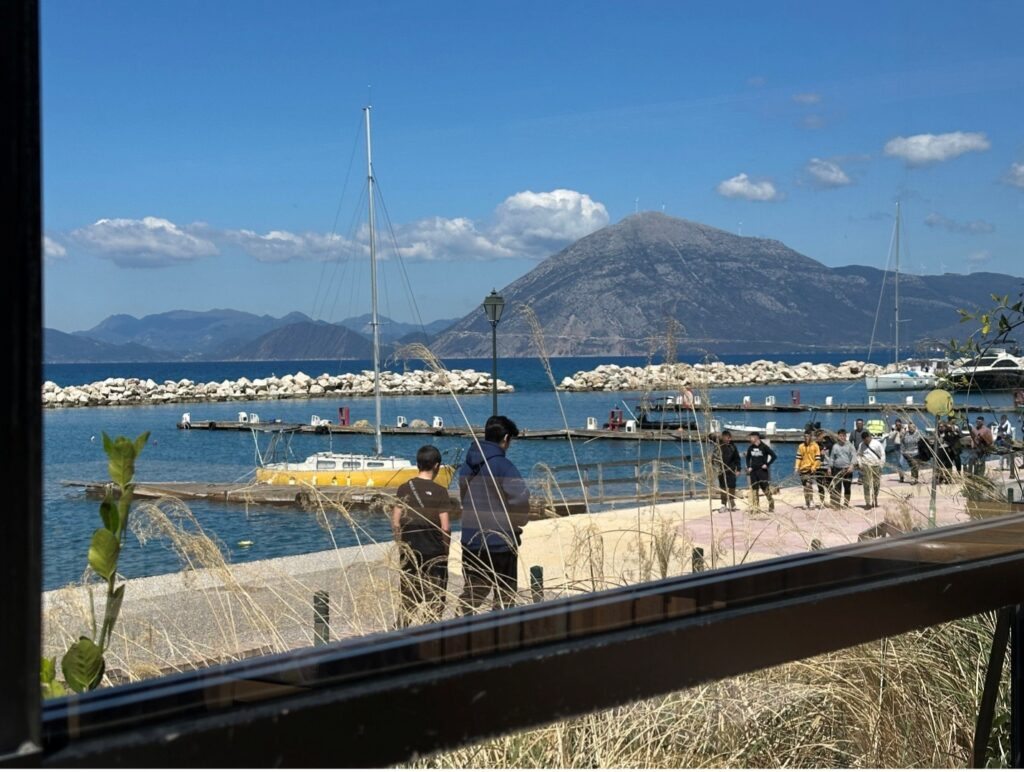
At this point, I started to feel the harbingers of a bad cold approaching, so I did little after visiting the museum and a very pleasant walk back to the Moxi – delighted as usual by the urban flora, including orange and lemon trees in back yards or wherever there was a small patch of earth.
Olympia
From Patra, I took a taxi to Olympia. An enjoyable, winding drive through villages and farms until you enter the historic region of Elis. The Elians guarded the shrines and temple of the Altis, the sacred precinct where the ancient Olympics were held every four years from 776 BC to 393 AD, when the Christian emperor Theodosius shut them down after the 291st Games. (It is unclear whether Theodosius l or ll made the final decision; the games may have gone on, on a small scale for a few years longer.)
An aside: At the 67 AD Olympics, the emperor Nero was awarded seven crowns, in the chariot race; the chariot race for 10 horses; the chariot race for foals; the competition for heralds; the competition for tragedy; the competition for lyre-playing; and for an unknown event. Several of the events were made expressly for him and were never held again. [AI research] This might perhaps remind us of winning golf tournaments at one’s own golf club.)
The winner of the stadion, the sprint, gave his name to the games of that year, and as the Greeks used the Games as the foundation for their calendar, you might give your birth year as “the third year of the eighteenth Olympiad when Ladas of Argos won the stadion” (Wikipedia example).
The area is very beautiful and grows more so as you approach the town, which is small and — at least in April — still very quiet, though the number of hotels, restaurants and gift shops give dreadful note of preparation forwhat the high season must be like.
Still fending off my cold, I walked from the hotel to the Altis, the sacred precinct, a walk of about 20 minutes. The last half of the walk is shady and beautiful, and you cross over a small tributary of the river Alfeiós (Alpheus) on a sturdy stone bridge, the water in the stream already very low this April. This is the kind of small, shady river that calls out for a swim, or maybe an inner tube. Once into the Altis – entry is €20 – you turn left up a broad street through a wooded park, to the museum, which is one of the truly great archaeological museums of Greece.
The majority of the exhibits are votive offerings made at the various temples, presumably for success in the games, or in gratitude for a win. Other votives come from all over Greece, usually in thanks for a victory in battle. One case holds a dozen or so bronze helmets (there are well over 100 more in storage), dedicated at the temple of Zeus, such as a shining bronze helmet taken from a Persian at Marathon, or perhaps Plataea (479 BC), the final, decisive Greek victory over the Persians, whom the Greeks called the “Medes.” Plataea was the only time all the Greeks fought together as one force — Spartans with Athenians, Megara, Plataeans — before the disaster of the Peloponnesian war erupted in a 20-year free-for-all that exhausted all parties and, ultimately, left the door open for Philip II’s Macedonian domination some 50 years later.

For me, the crowning jewel at the museum is the helmet of Miltiades, the commanding general at the battle of Marathon, in 490.

Another evocative exhibit is a simple, broken wine cup, or skyphos, on the bottom of which is scratched the name Phidias, the sculptor of the chryselephantine (gold and ivory) statue of Athena which stood in the Parthenon, and the giant gold and ivory statue of Zeus which stood in the temple of Zeus in Olympia. His workshop faced the temple and was of the same dimensions, allowing the statue to be constructed in the shop before moving it to the temple some 50 yards away. The workshop was preserved by being turned into a church, and still stands, roofless, today. The skyphos is a simple bit of pottery for use in the shop, the equivalent perhaps of the office coffee mug of today, with a “This is Phidias’ cup – go get your own!” in marker pen.
The helmets may be the crown jewels, as I feel, because they are actual, I-was-there objects at a turning point in Western history, but the sculptures from the east and west pediments of the Temple of Zeus are the dominating monuments. They are deeply familiar, larger-than-life and while fragmented, as imposing as they were when new in 460 BC – and as exhibited in the well-lit room that houses them today, far easier to see in detail than when they were in situ. The white austerity we are used to makes it hard to realize that when new, they’d have been richly painted. The Apollo is at the center, his dispassionate face reflecting a severe divinity, his outstretched arm seeming to favor the civilized Lapiths and Greeks in defeating the wild, uncivilized and only half human Centaurs. Mary Renault captures the effect of his face in The Mask of Apollo.

Patrick O’Brian, from a letter to Mary Renault, 1983, quoted in Mary Renault, A Biography by David Sweetman, pp 303: “We were in England last month and at a dinner party. I heard the man opposite me say your name: as soon as there was a pause I leant over and asked him what he had been talking about. A friend, he said, a friend with a merely scientific education who on meeting the Regius Professor of Greek at Oxford asked what he should read to gain insight into the Hellenic world. “Oh Mary Renault every time,” said the excellent Professor. “Mary Renault – perfect for historical accuracy, perfect for atmosphere.” I could hardly have put it better myself.”
The museum, and the walk to it, were about all I could do for the day, so I returned to my hotel for a thorough nap.
Next — Part 3: Back to Olympia and on to Nafplio
Nathaniel Brown taught and coached cross-country running and skiing for 16 years before joining the US Biathlon Team as wax technician, switching to the US Cross-Country team in 1989. He was the first American to take over technical services for a foreign team (Slovenia) and worked also for Germany and Sweden. He coached at three Olympics and 14 World Championships, edited Nordic Update for nine years and Cross-Country Skier for two. He has written three books on skiing and training; the latest was The Complete Guide to Cross-Country Ski Preparation (Mountaineers Books) which has gone through two editions and a Russian translation. He owned and operated Nordic UltraTune, an international freelance ski tuning service, until retirement.


Real first and last names — as well as city of residence — are required for all commenters.
This is so we can verify your identity before approving your comment.
By commenting here you agree to abide by our Code of Conduct. Please read our code at the bottom of this page before commenting.