
Will you chip in to support our nonprofit newsroom with a donation today? Yes, I want to support My Lynnwood News!
Welcome to our monthly column by and for local gardeners.
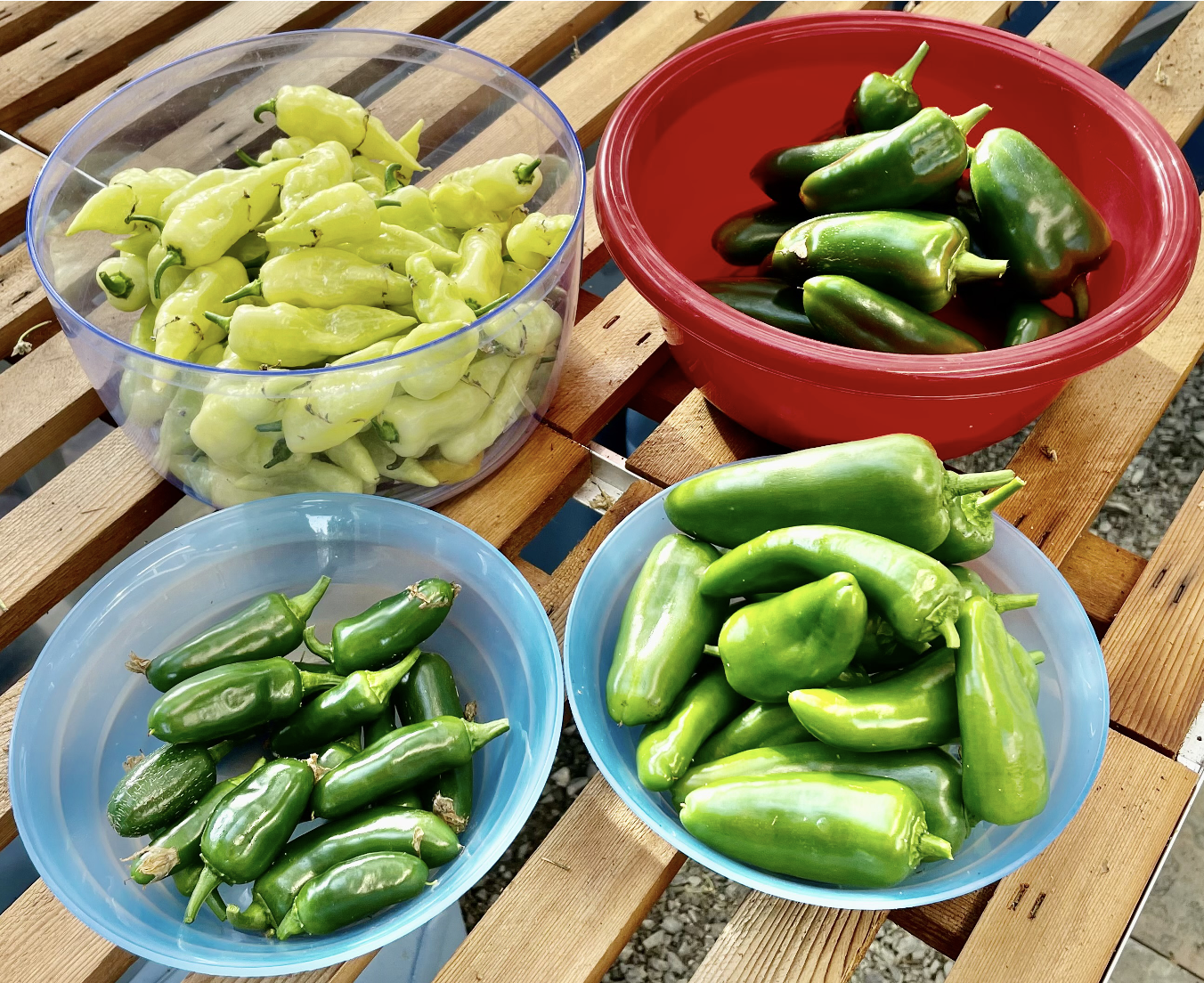
Peppers are a colorful, tasty and sometimes hot addition to our gardens. They are an interesting plant with a special property that propels some to celebrity status.
I grow peppers because I think they are fun. They offer some horticultural challenges that appeal to me, and in a good year that fun also provides some home-grown fruit. Sure, I like to eat them, though not so much for the heat. I think the plants themselves are handsome and I like to dabble with them in my greenhouse over the summer.
Basically, I enjoy it and that’s a good enough reason for me. Here are some things I have learned on my ongoing journey into the wacky world of peppers.
The basics
Peppers are in the genus Capsicum. They are native from northern South America to southern Mexico. There are five cultivated species, the most widely grown of which is Capsicum annum which includes bell, jalapeno, poblano and cayenne peppers.
Their interesting properties were recognized long ago.
People in what is now Mexico are thought to have started cultivating peppers around 6000 BCE. They were bred for fruit size, fruit color, fruit shape and of course, heat.
Peppers bring the heat
Ah yes, the heat. That is what makes the pepper plant special (notorious?). The heat comes from a class of compounds called capsaicinoids, of which capsaicin and a close analog, dihydrocapsaicin, are the most prevalent.
Why do our mouths burn when we eat peppers containing capsaicin, you ask? Let’s take a deep dive. This is the kind of stuff I really like about plants, so bear with me. I promise to get to information about growing peppers and … teaser alert! … how to look like a hot-pepper stud in a pepper-eating showdown.
Capsaicin is a molecule that activates heat-sensitive TRVP1 (Transient Receptor Potential Vanilloid 1) receptors in the mouth, eyes and gut. This receptor sits in cell membranes and is normally activated by high temperatures (> 109 °F).
When capsaicin binds to the TRVP1 receptor, your mouth thinks it is seeing high heat, but it is not. It is fooled. Your body then does what it needs to protect itself from this perceived heat – giving you a burning sensation, tearing up your eyes and sweating with mild exposure.
Why would a plant evolve to make such a compound as capsaicin? Because it’s good for the plant, of course! Capsaicin has antifungal properties and protects the seed from fungal damage.
Capsaicin deters mammalian predators. We’ve all seen what happens when a dragon eats a hot pepper! Interestingly, the capsaicin also aids in seed dispersal. Birds don’t have the TRVP1 receptor, so they don’t “feel the burn, baby” like we mammals do. Birds can eat the fruit in comfort and disperse the seeds through their droppings.
Why do humans like peppers?
Capsaicin makes sense for the plant. Why do WE eat hot peppers? Seriously, why would anyone purposely consume something that they know will make their mouth feel like it is on fire?
From a purely practical point of view, people have eaten hot peppers for thousands of years because they are food. The heat came with the food. The more you eat them, the more you can accommodate the heat. The heat of peppers also adds variety to food, like spices do.
For those of us who didn’t grow up in a native pepper growing region, the reason leans more to the thrill of it – the prospect of getting a burning sensation in our mouths without actually hurting ourselves. It reminds me of people who enjoy scary movies. They experience the thrill of danger and horror in the complete safety of their living rooms.
There may also be a bit of rush from eating a hot pepper. When we activate our pain pathway, our brain releases some good feelings via endorphins and dopamine.
As part of my “research” for this column, I watched a few YouTube videos of people eating hot peppers. I had to stop. The pepper rush wasn’t nearly as obvious as the pepper pain, and watching people suffer wasn’t a rush for me.
Measuring pepper pain
The heat from hot peppers — caused as you now know by a molecule called capsaicin tricking our bodies by triggering a false-alarm heat response — is measured in Scoville Heat Units (SHU).
The American pharmacist William Scoville came up with the SHU scale to standardize the measurement of heat in peppers. It is the amount that pepper extract needs to be diluted before there is no more perception of heat.
For example, a pepper rated at 5,000 SHU means a teaspoon of the extract from this pepper would need to be diluted with about 6.5 gallons before the heat is gone to the taster. And 5,000 SHU is a pretty wimpy number for a pepper. I have summarized the relative heat content of some selected peppers in the table below.
| PEPPER | SHU |
| Bell | 0 |
| Jalapeno | 5,000 |
| Tabasco | 40,000 |
| Cayenne | 50,000 |
| Habanero | 225,000 |
| Carolina Reaper | 1,641,000 |
| Pepper X | 2,693,000 |
I think a jalapeno pepper is hot, but the habanero is about 45 times hotter. Yikes! The hottest pepper in the world, according to the 2023 Guinness Book of World Records, is the mysterious Pepper X. It is a whopping 539 times hotter than the jalapeno! Pepper X is a relatively new heat champion, beating out the better-known Carolina Reaper by about a million SHU.
Where’s the heat?
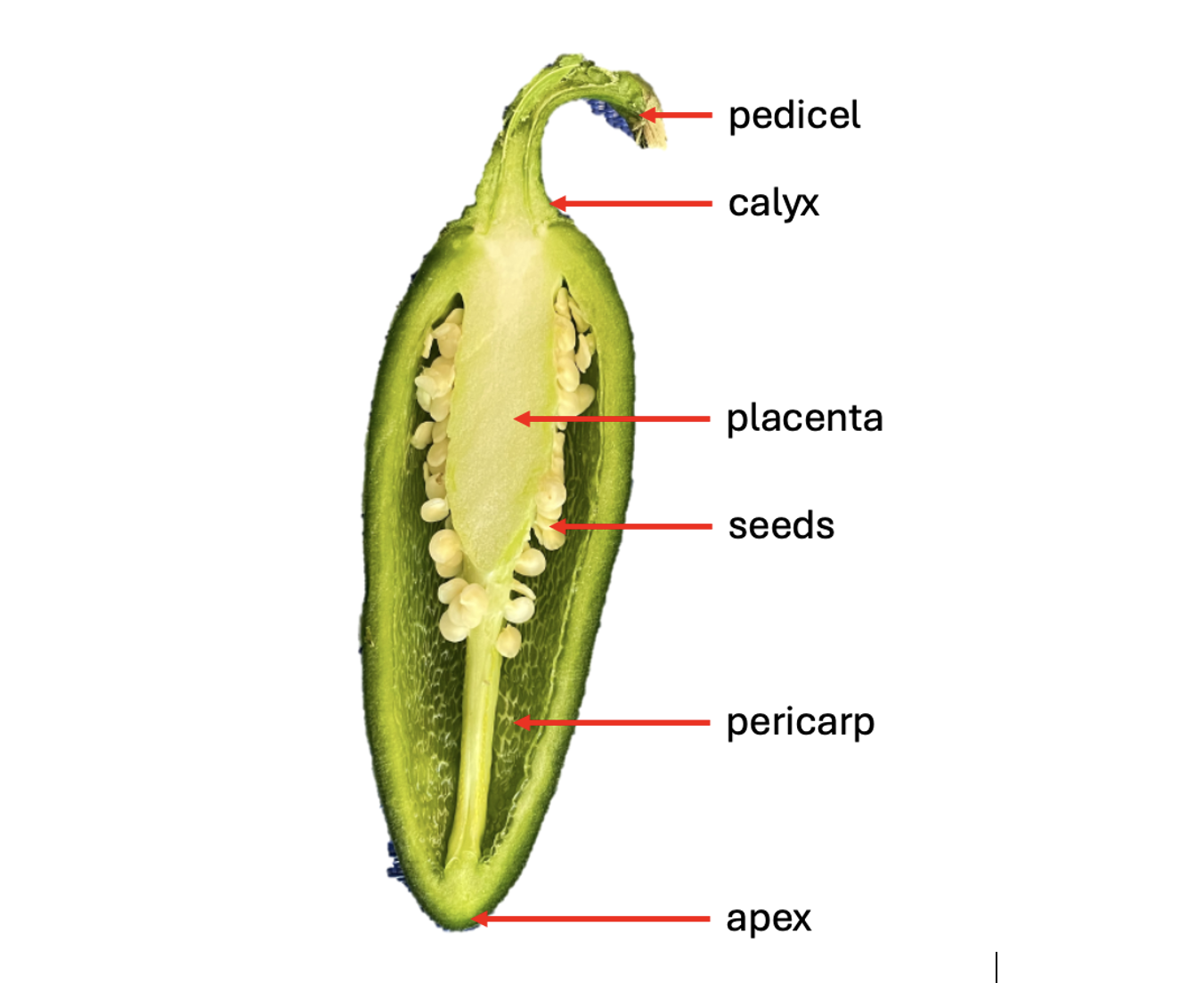
Knowing where in the pepper the capsaicin is located can help you avoid some of the burn and give you insider knowledge to win a pepper-eating contest. The tissue with the highest capsaicin content is the placental tissue inside the fruit to which the seeds are attached.
Next highest is the seeds. The fleshy fruit wall has the lowest capsaicin content. If given a whole pepper to test your capsaicin-tolerant mettle, take a bite from the apex end and you will avoid the highest levels of capsaicin.
If you want to eat hot peppers for the flavor instead of the burn, you can remove the seeds and placental tissue that they are attached to. This is what a capsaicin-weeny like me does when I make jalapeno poppers. I scrape out the “guts” of the pepper pod –- the placenta and seeds — and just eat the milder fleshy fruit wall (accented nicely with melted cheese and bacon).
You can use this background information to captivate your friends at summer backyard barbeques: “Dude, did you know the capsaicin in peppers binds to the TRVP1 receptor in our mouths?” You’ll be a big hit, trust me.
Good luck, gardeners
For those of you reading this to learn something about actually growing peppers in your garden, read on.
There are two critical ingredients to growing peppers in Edmonds: heat and sun. We do well in the sun category in the summer, but we have a problem with the heat.
Edmonds is a lot closer to Canada than to Mexico, and last I checked, Canada is not a major exporter of peppers. Peppers need a daytime temperature of 70 to 90°F and a nighttime temperature above 60 to 65°F.
Another issue is that peppers have a relatively long maturity time of 90 to 150 days. Compare that to veggies that thrive here such as lettuce (50 days) and radishes (25 days).
I grow my peppers in a greenhouse because I am fortunate enough to have one. It would sit empty most of the summer if I didn’t grow something in it, so I choose peppers. The greenhouse allows me to extend the growing season of long-maturing plants like peppers.
Furthermore, the greenhouse in the summer can provide consistently warm temperatures. The challenge is more to cool it than to heat it. Fun fact: my greenhouse reached a high temperature of 105 °F the other day. Even my peppers thought that was a little too hot for them!
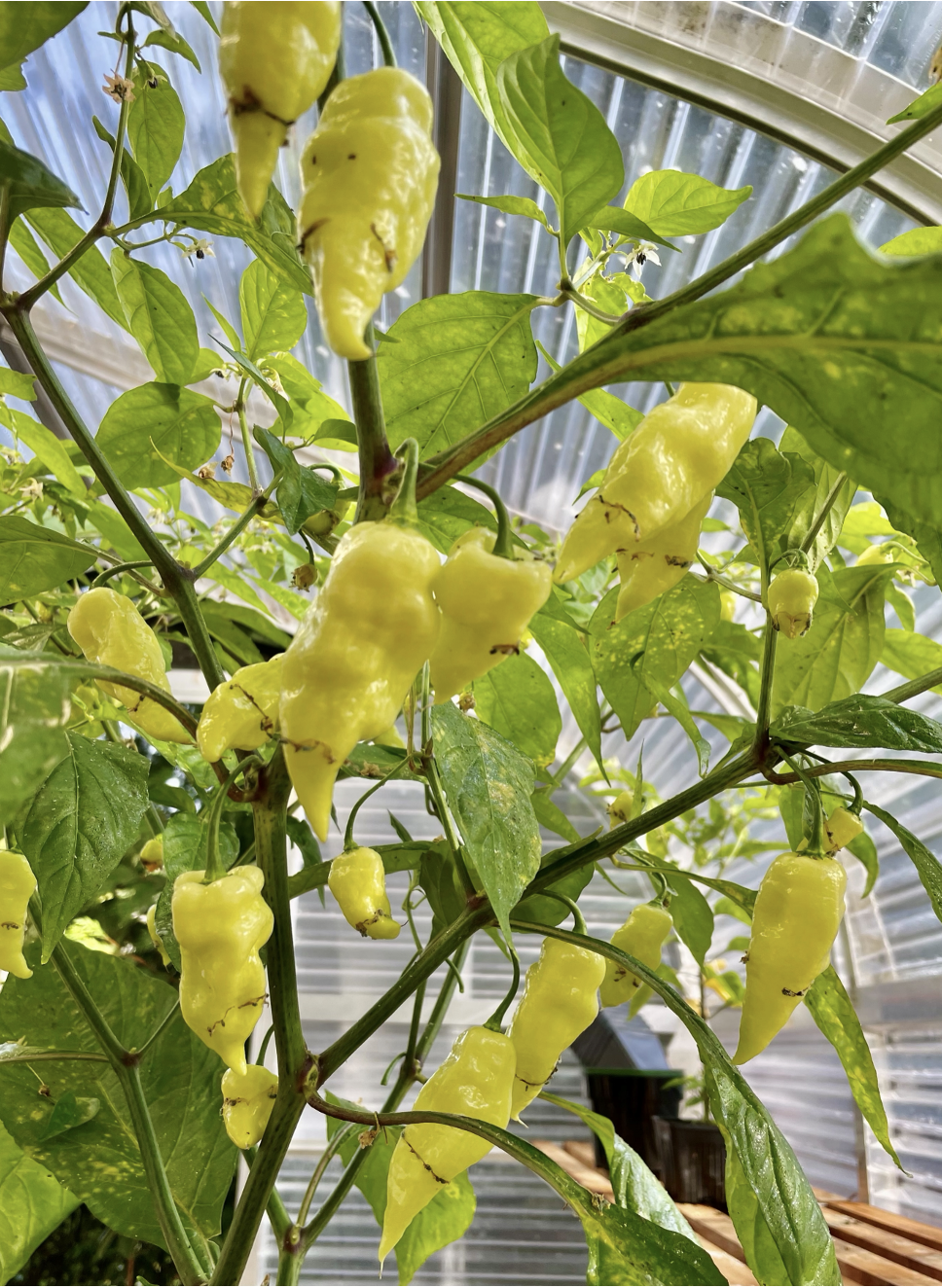
Peppers growing in my greenhouse.
For growing peppers outside, choose a sunny, hot location. A garden bed or pot next to south-facing wall would be a good choice. There’s nothing exotic about soil, water or fertilizer. Peppers like well-draining loamy soil that is slightly acidic (pH 6 to 7) and some balanced fertilizer, pretty standard stuff for most of the plants we grow.
You have two options for starting your peppers: from seed or a purchased young plant. For me, one of the real joys of gardening is growing a vigorous plant that you can eat all from a small seed.
I grow bell, jalapeno, shishito and habanero peppers from seeds, starting them early in the greenhouse on heating mats. They grow very slowly in the greenhouse until about July because I only add heat when the temperature dips below 45 ° F (a big brrrrrrr for peppers). They hang in there until July when summer weather finally kicks in and I typically start harvesting in September through October.
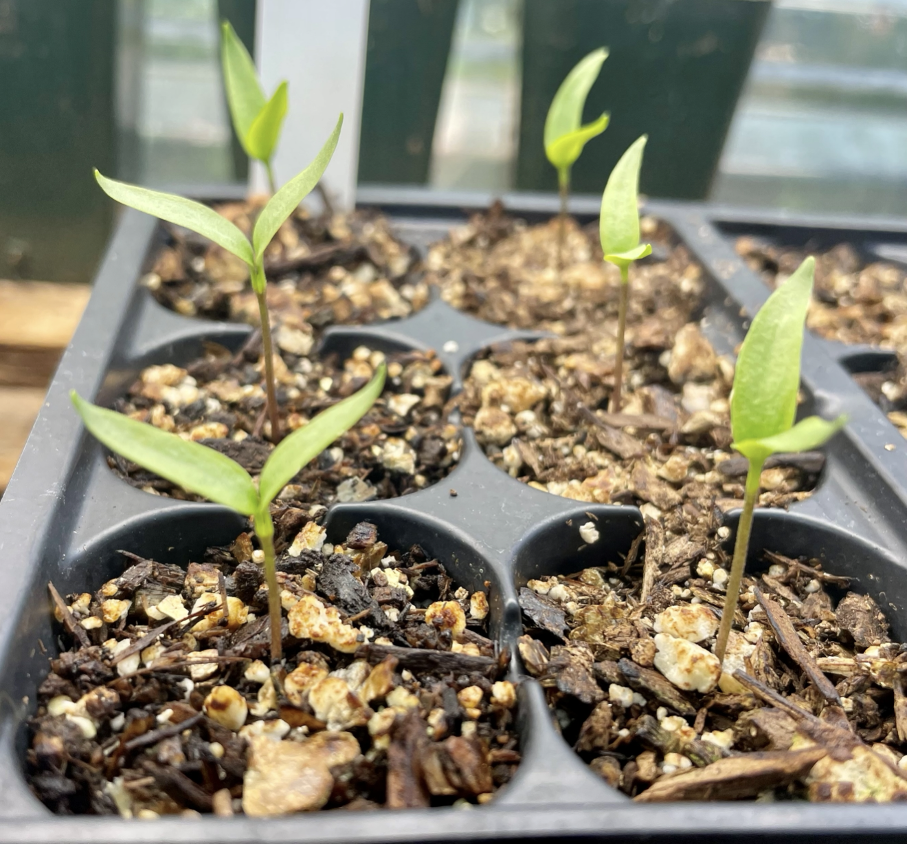
An excellent alternative is to buy pepper plants from a nursery. They have a huge jump in maturity and start yielding peppers (for me) in July. The disadvantage to this approach is that you don’t have as much of a choice of pepper varieties as you do if you start them from seed.
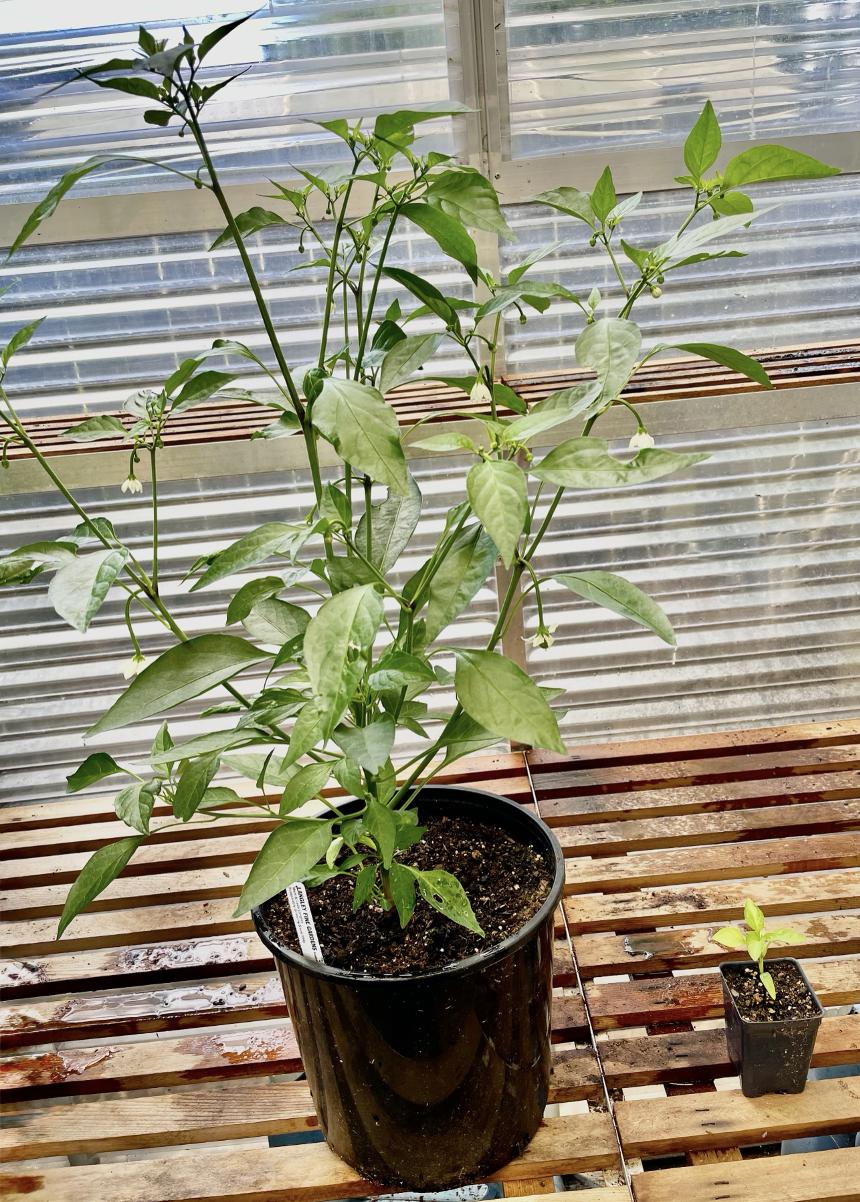
I bought the pepper above on the left at a nursery. I started the pepper above on the right from seed in mid-May. Guess which one will give me peppers first?
For example, I grow habaneros because, um, because, um…. I just think they are neat, and I have heard they are tasty. I buy seed from Habanero plants bred to have low heat (i.e. capsaicin) so someone like me can actually enjoy eating them! These are a challenge for me to grow so far, but I keep on trying.
Peppers are a colorful, tasty and interesting plant. Edmonds isn’t an ideal pepper-growing climate, but we can grow them in our gardens if we don’t get too exotic. For some, the thrill of peppers is in the burn which we now know is from the capsaicin molecule fooling our brains.
For me, I just like to grow them. So…. go ahead, intrepid Edmonds gardeners; grow some peppers for whatever reason makes you tick. Maybe I will see your uncomfortable face on a YouTube video soon.
Happy gardening!

Joel Ream grew up in Spokane and earned a Bachelor of Science in botany at the University of Washington and a master’s in botany at Michigan State University. Joel spent 37 years as a plant biologist at Monsanto, using plant physiology, biochemistry, and analytics to increase the efficiency of crop production. He also worked on new weed control technologies, regulatory studies to support the safety of new products, greenhouse and field evaluation of new crop varieties, increasing the nutritional value of animal feed, and developing methods to measure grain composition. Joel retired to Edmonds in 2018.
Article editor’s note: As a New Mexico transplant, I can’t let an article about peppers go out without mentioning New Mexico’s unique peppers, trademarked as Hatch Green Chile. All of New Mexico smells of roasting green chile this time of year. It’s the best smell in the world. We don’t take our chiles lightly; we eat them with everything. You can find them in Washington grocery stores now and roast them on your grill, or if you’re like my family, roast more than 100 lbs. in a giant backyard chile roast. — Marty Ronish


Real first and last names — as well as city of residence — are required for all commenters.
This is so we can verify your identity before approving your comment.
By commenting here you agree to abide by our Code of Conduct. Please read our code at the bottom of this page before commenting.