
Will you chip in to support our nonprofit newsroom with a donation today? Yes, I want to support My Lynnwood News!
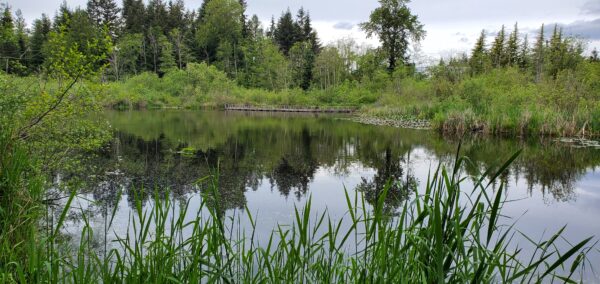
Foreword: In July 2019, historian Betty Lou Gaeng penned an article titled Lynnwood’s Peter Schreiber and Scriber Lake for My Neighborhood News Network.
Betty’s article recounted Peter Schreiber receiving a patent in 1891 to homestead 160 acres, including what is now Scriber Lake, which was located on the northeastern part of his property. Sadly, Peter’s wife Lavina died from complications of childbirth on April 5, 1895.
After her death, Peter moved his family to Edmonds to reside with Lavina’s parents. By 1910, most of Schreiber’s 160 acres had been sold to private investors or had been forfeited for delinquent and unpaid taxes.
This article will pick up where Betty’s article left off and will chronicle the history of the Scriber Lake area for the next 50-plus years, and the legacy of the Wilcox family around the lake.
Scriber Lake area: Circa 1905-1920
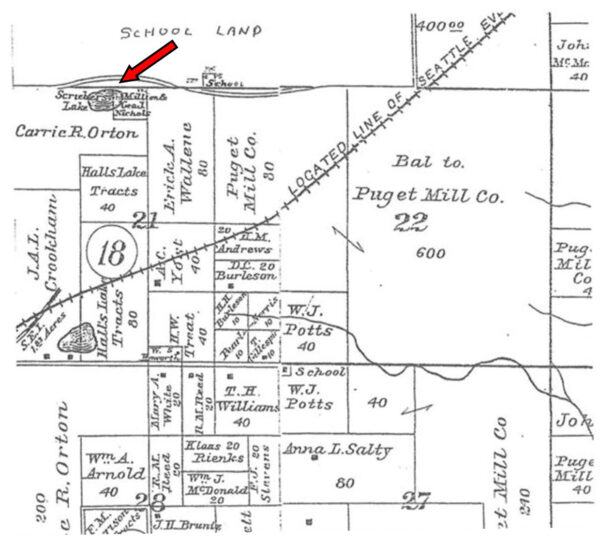
Author’s Note: Scriber Lake is positioned at the top left of the plat map.
By 1910, the land surrounding the lake was owned by Carrie R. Orton except for the eastern part of the lake, which was owned by W. Millicoats and George J. Nichols.
Carrie Orton had not purchased the property herself, but inherited it and other properties from her brother-in-law, Samuel Orton, when he passed away in 1903. Samuel had been successful in the real estate market in Kansas City before he began purchasing properties around the Northwest.
To the north across what was then known as the North Trunk Road or Alderwood Road was a large parcel denoted as school land. About a half mile east of Scriber Lake sat the Maple Leaf school, which was the school for the area’s students from 1904-1918.
Author’s note: North Trunk Road is now known as 196th Street Southwest.
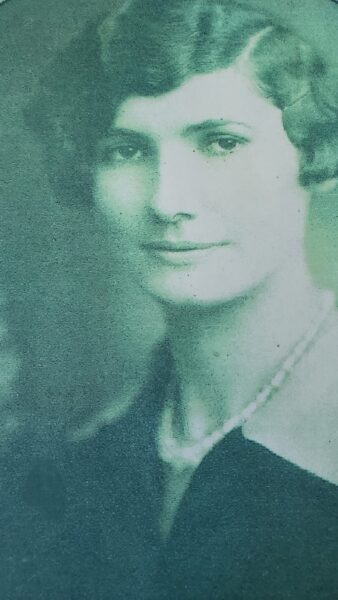
In her personal memoirs, one of Edmonds most revered early teachers, Adrienne (Addy) Caspers, recounted her experiences at the Maple Leaf school:
“In 1917 I was hired to teach in a country school in the Edmonds district. The school was about a half mile east of Schreiber’s Lake. I had six grades and was principal, teacher and janitor. One afternoon I took the children down to the lake to study the plants and animals, and to gather sphagnum moss, to be given to the army and navy for surgical dressings. We were late in returning, were tired and dirty. My hair was long and untidy because of the contact with tree branches.
“One can imagine the surprise and embarrassment when we were met by two members of the school board, who had come to visit. They stayed most of the afternoon. The children were physically tired, so they behaved beautifully and responded well. The credit goes to Schreiber Lake.
“Ah, me! Those were the good old days! Guess it taught us to appreciate the little things in life.”
As the years went by, other pioneers settled into the area. When Carrie Orton passed away in 1916, her property near Scriber Lake was subdivided and sold off to new settlers.
The Wilcox Family and their journey to Scriber Lake
Eugene Howard Wilcox and his wife Inga Gunvalda Jaeger Wilcox met in North Dakota around 1913. Eugene was born in North Dakota in 1887, and Inga was born in Iowa in 1894. Inga had been orphaned at age 6 when both of her parents had died in an influenza epidemic.
After her parents’ death she moved from home to home for several years, being taken in by different families. As she grew older, she took on house-cleaning jobs to earn money. After working for and living with an older couple – a judge and his wife – she chose not to be adopted by them and struck out on her own to homestead in North Dakota.
After a year and a half of acquaintance, Eugene and Inga were married in the spring of 1915. They chose to homestead in McKenzie County, which was described as having varying terrain ranging from prairie land to rugged badlands.
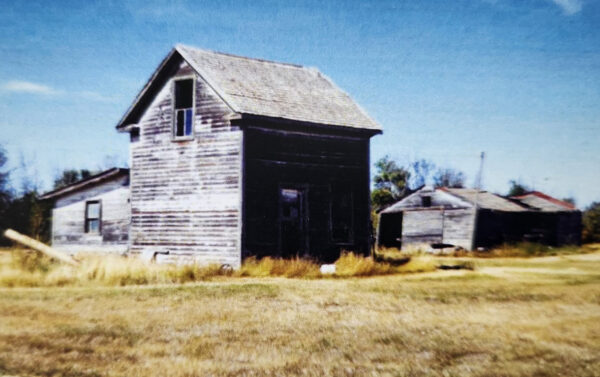
Life was tough. Mother Nature tormented them while they were there. While attempting to make a living by planting and harvesting crops, Eugene and Inga had four children in the first six years of their marriage.
Elizabeth Catherine (Betty) was born in March 1916, Kenneth Jaeger in August 1917, Vivian Lorraine in July 1919 and Ai (pronounced Ah-eye) Elsworth in March 1921.
Author’s note: Although Ai was his given name, Ai was known as “Al” by most people.
After several years of crop failures and barely eking out a living, Eugene, Inga and their four young children left their homestead and moved 100 miles west to Glendive, Montana where Eugene, who was an excellent carpenter, quickly found a job. While in Glendive, they welcomed their fifth child, Eugene Howard, Jr., into the family.
After working in Glendive for less than two years, Eugene heard that employment opportunities in Seattle were abundant. Given the chance for a better life, the elders packed up their meager belongings, five kids and headed west.
Upon arriving in Seattle, Eugene was immediately hired, and he worked on the construction of the Paramount Theatre, Bon Marche Department Store and other downtown buildings. With a steady job, the family moved into a rental house in Ballard. For the first time they had electricity, a real floor (not sod like in North Dakota and Montana) and running water. During their stay in Ballard, their sixth child, Harold Julius, was born in February 1925.
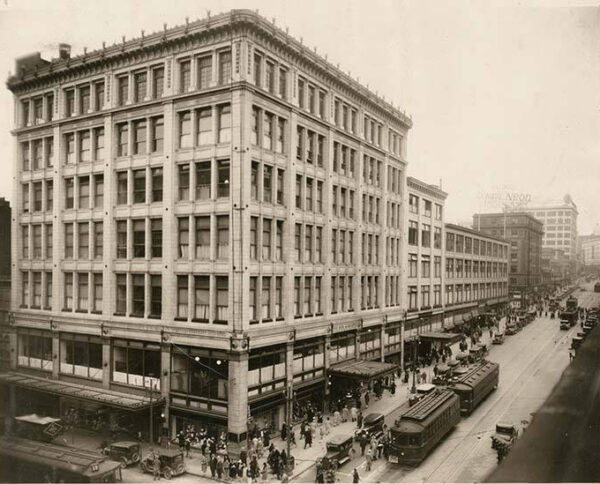
Things were good for the Wilcox family. Eugene had steady employment, and they scrimped and saved money so they could purchase their own home.
In the spring of 1926, Eugene and Inga purchased five acres on a hillside overlooking the southeast side of Scriber Lake from the Larson family. The area was commonly known as Alderwood Manor or Alderwood and was 15 miles north of Seattle. The five acres included two partially built chicken houses. The purchase price was $2,500.
Author’s Note: Throughout the remainder of this article, there will be multiple quotes from three of the Wilcox children’s written histories, personal memoirs or from articles they wrote regarding their family’s lives on and around Scriber Lake for the next 35 to 40 years. Betty Wilcox Munson’s memories will be noted as Betty, Ai Wilcox’s memories with Al, and Harold Wilcox by Harold. Betty was 10, Al was 5 and Harold was only 2 when they moved to the Scriber Lake area. Therefore, Betty was 10-13 years old during the first four years, Al was 5-8 and Harold was 2-5.
Settling in and the first four years: (1926-1929)
Al: “Dad converted one of the chicken houses into our family home and continued to work in downtown Seattle. Mom set up housekeeping in our new home and tended to the chores that came with five acres. It was a lot different here back then. It was a very rural place. There was only one other house nearby, and a house every 10 acres or so.”
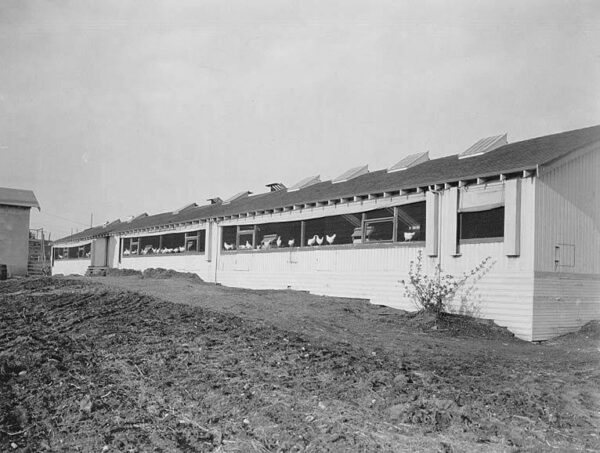
Author’s note: Although there are no known photos of Wilcox’s home in 1926, many of the chicken houses in the area were built like the one in the photo above. The style was one advocated by the Puget Mill Company who helped develop Alderwood into the second largest egg producer in the country at that time.
Harold: “When we moved into the house on Scriber Lake, it was already a little swampy and was completely without a beach. The driveway to our home was quite long and a bridge crossed Scriber Creek. Just about every spring the creek would overflow its bank, making the driveway unusable. This happened during the spring thaw, and the bridge would later drop back into its normal position and so that it was usable again. The driveway was used by the Carlson family whose house was to the northwest of us on the lake.”
Betty: “The Carlson family lived nearby on the creek where Wights Nursery is located. Other families in the area were the Hegels, Flints and Mattsons. Many of the elementary school kids walked a mile or more to the Alderwood Grade School built by the Puget Mill Company.”
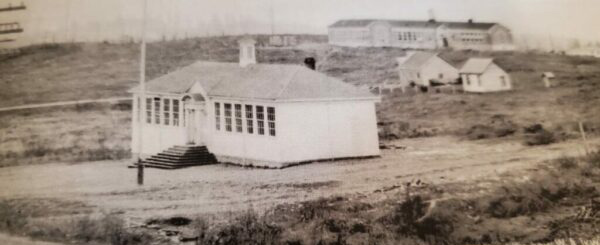
Al: “Alderwood was a great place for kids to grow up as we had lots of room to roam and play and freedom to enjoy it. I spent many hours at Scriber Lake swimming, fishing for trout and crappies, and doing anything else I felt like doing. One of my earliest memories is when I caught my first fish at Scriber Lake. I’d gone fishing alone, with the typical equipment of the time, a stick and a string, and some angleworm. I remember when I got the first fish on the line and pulled that trout out of the lake. I was so excited – I started screaming that I had caught a whale. I was told later that the trout was somewhere around 16 inches.
“We had a lot of good times, but life wasn’t all fun and play. We had to work, and each of the kids had their share of daily chores. There were pigs to feed, cows to milk, butter to churn, eggs to gather and so on. Before going to school each morning, I’d have to feed the animals, clean out the chicken coop or do a similar task.
“I somewhat enjoyed milking the cows, but I think the cows had mixed feelings about me. I’d sing ‘Home on the range’ to them as I did my milking and they’d occasionally kick my bucket, as if in protest.”
Betty: “I learned to swim in Scriber Lake. As kids we just jumped in and figured it out. There was some peat along the shore that helped you float a little, but the lake was real clean looking. As the trees grew in, they would die. There wasn’t enough to keep them alive.
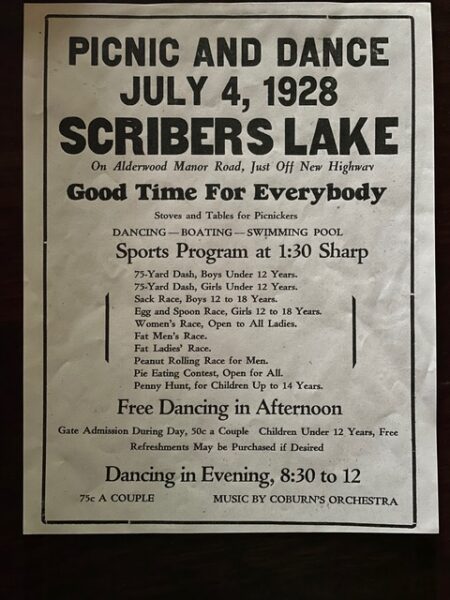
“The Barclays built a resort on the southwest corner of the lake a year or two after we moved in. They built a beach and had cabins. City people used to come out to stay in their cabins and at one point they had a swimming pool.”
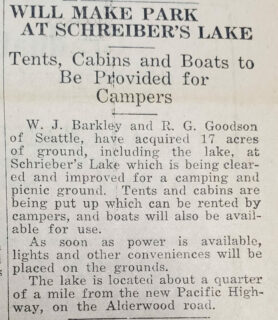
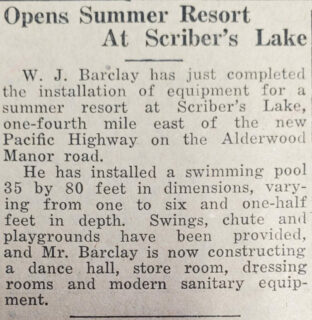
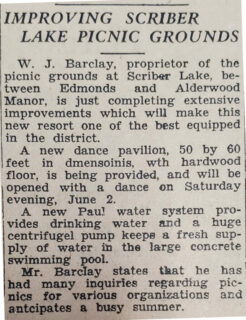
(L-R): 1926 announcement of plans for Scriber Lake Resort and 1927 and 1928 announcements regarding its opening plus expansion and improvements.
Betty (continued): “They also built a large dance hall. I went there a few times with my parents. Later a family named Henam bought the resort from the Barclays.”
But not all the activities in and around the lake were without peril.
Betty: “The boys built a raft on Scriber Lake causing my mother, Goody, who could see them from the house, no end of worry. They fished and dove in off the rafts. Stories were told about the lake being bottomless, and anyone who drowns in it would never be found.”
Author’s note: Mrs. Wilcox, Inga Gunvalda Jaeger Wilcox, was known by the name “Goody” by most people.
Harold: “Most of my memories of Scriber Lake are good ones. But one is not so good. There was an opening about a foot and a half between the boardwalk and float (raft) and this was nearly the cause of my demise. I don’t remember what happened, I was probably running and slipped into the water through the opening and was unconscious when I was pulled out. I was resuscitated on an overturned boat next to the boardwalk. I was only five years old at the time.”
Al: “I have a vivid memory of going down to the lake with my brother Eugene, who is two years younger. Somehow Eugene got stuck in the mud up to his waist in the creek that drained the lake. I was probably about eight years old, but as the big brother it was up to me to rescue Eugene. Well, I rescued Gene, but I got myself stuck too, and all of that was left for us to do was to holler at the top of our lungs for our mother at our house up on the hill. Eventually she heard us and came to our rescue.”
Author’s note: In June 1928, Eugene and Goody welcomed their seventh child, Iris Ardelle, to the family.
U.S. stock market crashes and the Great Depression begins:
On Oct. 28, 1929, the U.S. stock market crashed and set in motion the Great Depression of the 1930s. In some areas, the depression was almost immediate with people losing their jobs, going on relief, standing in line for food in soup kitchens, etc.
Fortunately, Eugene retained his employment working in Seattle remodeling apartments for $3 a day. It wasn’t much but it kept the Wilcox family on their property and going for the first two years of the depression.
On June 11, 1930, Goody and Eugene welcomed their eighth child, Lorna Shirley Lois Wilcox, to their modest home.
The following month, it was announced that the North Trunk Road was going to be paved and bids for the work were being accepted. The two-mile dirt road ran from Alderwood to Highway 99, which had been completed in 1927. This stretch of road included an earthen bridge which spanned the northern part of Scriber Lake and Scriber Creek, which flowed into the lake from the northwest.
In October, it was announced that an agreement with the State of Washington to pave the road had been reached, and that preliminary plans were being put in place for the beginning of the construction.
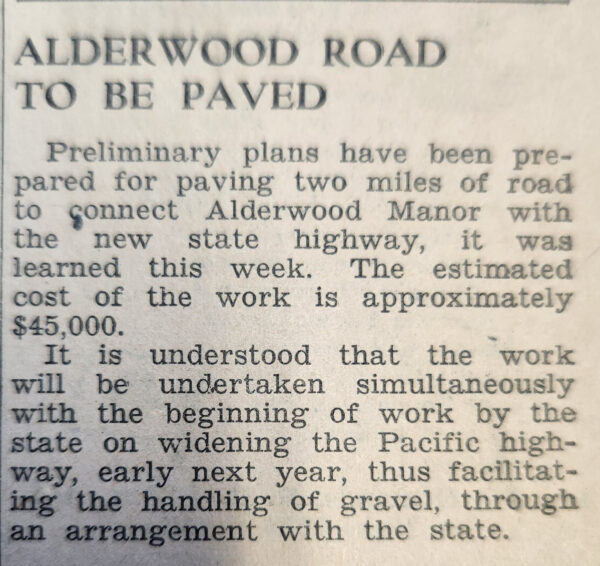
Harold: “A new bridge was to span Scriber Creek and the northern part of the lake. A pile driver was brought in to drive pilings down to solid ground to provide the support the bridge required. I can still visualize the pile driver in action and hear the sound it made. Cost for the road construction was estimated at $45,000. The bridge deck was concrete, and the road just west was asphalt, and every year asphalt had to be added because it kept sinking. There must have been quite a few feet of built-up asphalt underneath that part of the road.”
Betty: “Construction of the original 196th Street SW in about 1931 was a turning point for Scriber Lake. It was a good lake until that time. They drew water out and it pulled the algae up. Not only did the water get murkier but the lake shrunk in size, as the development encroached on it. Old-timers say the lake was much larger. The construction of fill for the four-lane highway pushed the peat down into the bog causing an isthmus of peat to pop up in the lake. Through that process the construction of the road reduced the size of the lake by one third. We didn’t swim in the lake then, instead we walked a mile south to Halls Lake to swim.”
Author’s note: Architects at the time stated that the portion of the lake north of the new highway bridge basically disappeared and became a marshy area. The lake itself, they theorized, was left as a depression from an ice block dating back over 11,000 years.
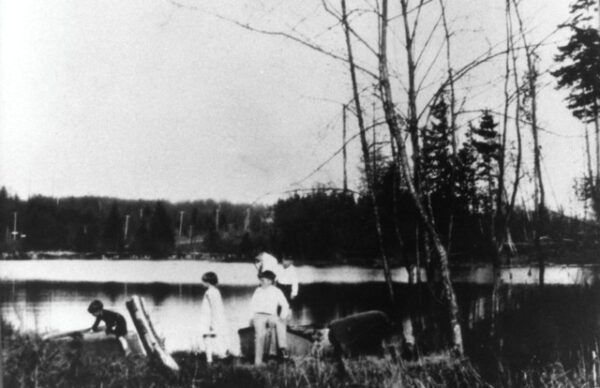
The final stages of the paving and construction of the bridge on the North Trunk Road were completed by the end of 1931.
End of Part I. Credits will be provided at the end of Part II.


Real first and last names — as well as city of residence — are required for all commenters.
This is so we can verify your identity before approving your comment.
By commenting here you agree to abide by our Code of Conduct. Please read our code at the bottom of this page before commenting.