
Will you chip in to support our nonprofit newsroom with a donation today? Yes, I want to support My Lynnwood News!
My Neighborhood News Group (MNNG) is publishing a series of stories on how local governments are funded and the financial challenges facing both elected officials and residents. You can read Part 1: Introduction here. Part 2: Where’s the money here. Part 3: Property taxes here. Part 4: Fees and taxes here. Part 5: Federal and state grants here. Part 6: The difference between wants and needs here.

“Well, I’m curious to know before reallocating or repurposing restricted funds, if the council should first publish a detailed analysis showing exactly how much of each source is legally and practically available, and how using those funds now won’t simply postpone a deeper structural correction later…” Nov. 8, My Edmonds News comment section
Another hurdle for local governments is how money is used.
People may think that a mayor or city manager or city council has total control over the budget. They can move this wastewater utility tax money to cover that construction project, which is currently over budget. Maybe borrow a little from that federal fund (tapped for a new bridge) and use it to make repairs at the local city pool.
That makes sense. When we own a home, we may decide to use vacation money to pay for a new roof because we need a new roof now and we can choose a staycation.
In this case, a local government is nothing like our personal economy. That is mostly not allowed. Money must be tracked and responsive to a state audit.
Most local government funding comes with regulatory restrictions. Some refer to this concept as “the color of money.”
Green money can be used for green projects. Yellow money can be used for yellow projects. Green money cannot be used for yellow projects. And it is all documented and subject to a state audit. Using money for the wrong purpose can produce a state audit “finding” and, on occasion, a fine.
“Private individuals or organizations, as well as state governments, typically have the ability to move their funds from one category of spending to another to adjust to current needs,” Snohomish County spokesperson Kari Bray said.
“That’s not the case for much of the funding we manage as County government. We must spend specific funding sources in specific ways. If we have money that has been legislated or contractually obligated for a particular use, such as a dedicated revenue stream under state law or a federal or state grant, we cannot reallocate those funds to meet other needs,” she added. “This means our limited flexible funding (namely our general fund) gets disproportionately pinched by emerging needs or cost increases as it is one of the only places where we have that flexibility in use of funds.”
Money that doesn’t have a color is in the general fund — but even that can have colored restrictions. It pays for everything from people to products, from staples to services, from health insurance to buildings to software.
Fines and lawsuits
If local governments don’t do what they are mandated to do, they face fines or lawsuits, which can be very, very expensive. Dirty creek water? Fine from the Department of Ecology. Moved money from a green project to a yellow project? Maybe an audit finding.
There’s a new problem. It’s very expensive.
It is called “Legal System Abuse.” That’s according to the Insurance Information Institute, a nonprofit that tracks insurance claim data and identifies trends.

“Excessive verdicts and litigation behaviors have fueled a structural rise in claim costs that continues to increase costs for insurers and policyholders alike,” Insurance information Institute CEO Sean Kevelighan said in an October 2025 news release.
Local governments are self insured. This is referred to as the “public entity liability market.” Liability lawsuits and damage claims for local governments are skyrocketing.
Municipal insurance rates have nearly quadrupled in Washington state since 2020.
In non-industry speak, it means people sue the government and win. They win often and they win a lot of money. Attorneys specialize in suing or making damage claims against the government because attorneys make a lot of money too. They generally take a third of the payout.
An unfilled pothole causes damage to your car? File a claim. Local governments are liable and pay damages.
Government has so-called “deep pockets” because, unlike the person who sideswiped you on Highway 99 last week, governments must carry insurance. People know this. More important, attorneys know this.
Government may not always be to blame, but a settlement is always cheaper than a trial. Every time a claim is settled, the city’s insurance company pays out. Next year, the city’s insurance premiums go up.
Going back to our personal economy: You have a really bad string of luck. A small fire destroyed the kitchen last year and you made an insurance claim. This year, a huge windstorm brought a tree down on your roof and you made a claim. That “act of God” doesn’t matter. And it’s also not your fault!
Your insurance company now triples your premium because you made two claims in two years. (Or maybe they even drop you without telling you, like the folks in Pacific Palisades, California, who had State Farm Insurance that covered brush fires.)
You can shop around for another company or go without insurance (if you own your home). A city can’t do that. Premiums just go up and up and up. And every year, the entire annual premium is due in January.
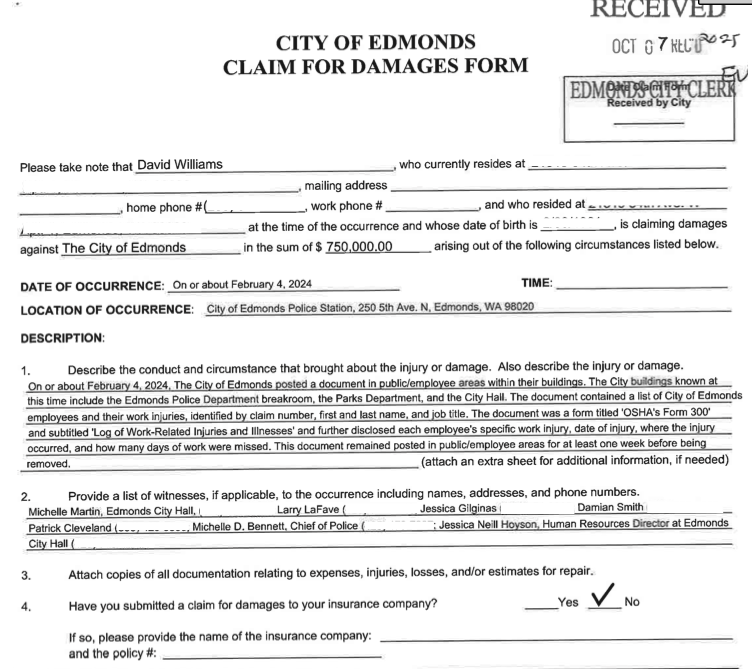
Here’s an example of these type of claims, from an October Edmonds City Council meeting: According to paperwork filed, three former workers and one current employee filed damage claims against the city for $750,000 each because their names and injuries and time off related to those injuries were posted in a city breakroom for a week. If they get what they want, that’s a $3 million payout, which is covered by the city’s insurance company.
That claim hasn’t been paid — yet. Even if it isn’t, it will require the city attorney’s legal time and a lot of negotiation. Legal conversations cost money.
Where does that premium increase come from? Take money from another pot of money? The city can’t do that because the money is earmarked for something else. And if the city does, it is audited and fined.
This is what makes the current state of local government and our increasingly litigious society so challenging.
It happens on a large scale too. In late November 2025, the family of a Monroe woman killed by a drunk driver on US 2 in Snohomish County filed suit against the Washington State Department of Transportation for $50 million. They say the state should have done more to protect her from the drunk driver because US 2 has a history of crashes. Where will that money come from? The state currently doesn’t have enough money to fix US 2. So if it happens again, will they be sued twice? Maybe.
The Washington State Standard reported on this issue in September from the state perspective.
Next: If cities functioned like a business, would this financial problem would be solved more quickly and more transparently?


Real first and last names — as well as city of residence — are required for all commenters.
This is so we can verify your identity before approving your comment.
By commenting here you agree to abide by our Code of Conduct. Please read our code at the bottom of this page before commenting.