
Will you chip in to support our nonprofit newsroom with a donation today? Yes, I want to support My Lynnwood News!
Where does a councilmember’s authority begin and end? How does the City pay for major transportation projects while funding wanes for critical maintenance and basic traffic safety improvements? These were some of the questions answered at the March 16 Lynnwood City Council meeting, where Councilmembers learned how to avoid liability and discussed the future of transportation in Lynnwood.
Transportation
The second half of the meeting featured a briefing from Public Works Director Jared Bond, Engineering Manager Nick Barnett, and City Engineer David Mach on the 10-year outlook for major transportation projects and funding for Lynnwood’s general transportation operations.
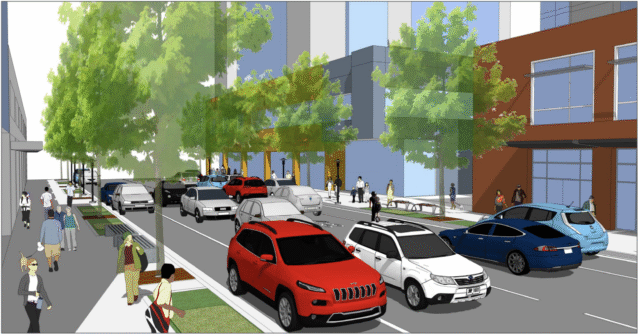
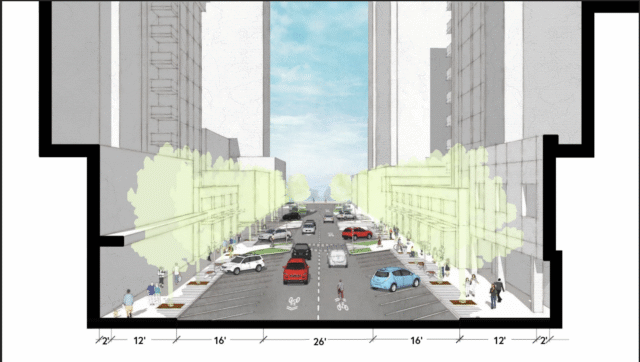
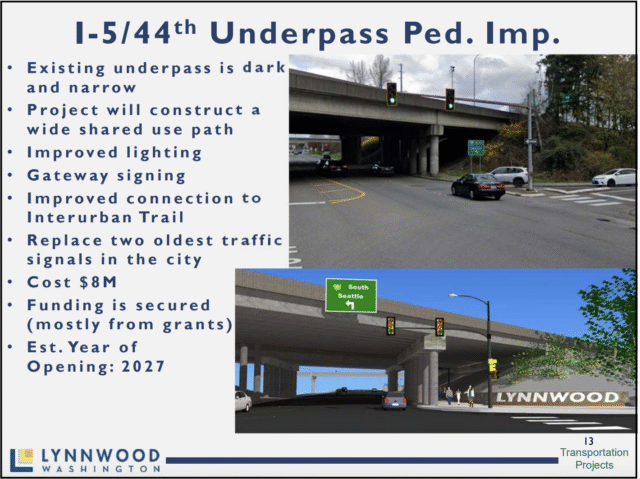
Mach highlighted upcoming capital projects, including pedestrian and bicycle improvements to the 44th Avenue/I-5 underpass and the Poplar Way Bridge, both set to enter construction this year. Mach said Poplar Way construction could begin as soon as April. Other projects scheduled for the next 10 years include a new “ring road” for the Lynnwood Event Center campus redevelopment, Costco street improvements and the 42nd Avenue West project to redevelop the blocks surrounding the future light rail station near Alderwood Mall.
Staff recommended the City spend its annual $14 million transportation fund on the aforementioned projects, plus limited street paving and improvement projects.
Lynnwood has about $14 million in its transportation budget, with over half coming from grants at $8.5 million. Given grant spending is usually restricted to specific projects, staff recommended spending the transportation funds on the major transportation projects, plus limited street improvements.
Mach said very little money remains for three categories that residents have consistently marked as top priorities in surveys and community outreach efforts: street paving, traffic safety, and pedestrian and bike improvements,. Using those categories, staff organized projects into three “packages” that the City could pursue additional funding for.
Package 1: Traffic safety
- This package includes speed reduction projects like speed bumps, traffic islands and speed radar signs. Funding could also be used to install new traffic signals at busy intersections where needed.
Package 2: Walking and biking improvements
- Staff called this the “Connect Lynnwood” package, as it closely aligns with the City’s long-term transportation plan under the same name. It includes construction of new sidewalks on streets without any, new bike lakes and racks and mixed-use trails. The replacement of “substandard” ADA sidewalk ramps could also be funded by this package.
Package 3: Street paving
- Mach said Lynnwood’s street paving program is very limited, with only $2.5 million budgeted annually out of the recommended $5 to $6 million. The lack of funding led staff to prioritize paving major roadways and streets in critical condition over regular maintenance. However, the City recently purchased a paver, allowing staff to increase internal paving jobs. Lynnwood Public Works Director David Bond also said the City’s streets maintenance team is short staffed with only about four employees. A City study from the 1980s determined the department would need seven employees to handle the demand, and Lynnwood has grown significantly since.
Councilmember Isabel Mata questioned the choice to prioritize funding for the larger capital projects, despite the need for critical maintenance and residents’ desire for safer neighborhood streets.
“As a City we’ve talked about wanting to make this city a lot easier for people to walk and bike in,” Mata said. “Yet based on the numbers here, we’re actually prioritizing movement by cars… I think we almost need to force a hand at some point by just making it more difficult for the massive amounts of cars to be on the road.”
Mach agreed with Mata about the need to maintain current infrastructure, but said there are more grant dollars available for large capital projects than for regular maintenance and City operations.
“We really try to get as much done with the limited funding we do have,” Mach said.
Staff then broke down the City’s transportation revenue sources, identifying potential leads for more money. Other than grants, the Transportation Benefit District (TBD) is the City’s largest revenue source for transportation, pulling in about $4 million annually. A TBD is an independent taxing district formed by local governments to fund transportation projects, according to the Municipal Research and Services Center.
Other revenue streams include Transportation Impact Fees (which bring in roughly $750,000 a year from developers) and the Real Estate Excise Tax (which contributes roughly $1.5 million).
Formed in 2011, Lynnwood’s TBD is funded by its $40 car tab fees and a 0.1% sales tax. Approved by Lynnwood voters in 2017, the sales tax generates an estimated $3 million a year, City documents say. State law allows governments to collect the tax on a 10-year cycle and previously required a public vote to allow the City to continue collection the next decade. However, changes in state in 2022 law removed the requirement for a public vote, leaving the decision up to the Council.
With the 10-year deadline approaching, staff plan to bring the matter back for a Council vote sometime in the spring. Mach recommended the Council approve it, given it’s one of the few consistent transportation revenues available.
As far as additional funding opportunities go, governments are allowed to increase vehicle tabs fees to $50 by a Council vote and up to $100 by a public vote. The City could also increase the sales tax to 0.3% with a public vote.
Staff floated other options, including raising impact fees up to $12,000 per home, proposing a bond measure to raise the property tax, or reviving the Economic Development Investment Fund (EDIF) — which used to dedicate $1 million in construction sales tax to transportation before the City suspended it in 2020. Mayor George Hurst, who was on the Council at the time, said the Council suspended the EDIF to absorb the money into the shrinking general fund.
Despite getting more revenue from the TBD, plus a state gas tax, the City’s ability to complete projects decreases every year, Bond said. He attributed this in part to inflation, but stated the gas tax also brought in less money than expected. In order to balance the budget, the City had to pull from other transportation funds to supplement where the gas tax fell short.
City Engineer Nick Barnett said market conditions have also caused project costs to skyrocket.
“The City doesn’t really have the ability to seek the absolute cheapest bids out there,” Barnett said. “State bidding law basically mandates that we have to do an open bid, and then it becomes a competition between contractors. Sometimes that drives a price down, sometimes it doesn’t.”
In recent years, larger contractors have bought out smaller companies, limiting the City’s options and “bidding higher than everybody else has ever seen,” he said.
When Barnett first joined the City in 2015, the Poplar Way Bridge cost estimate was around $25 million. In 2025, the awarded the construction bid for the bridge at $45 million.
Bond said changing laws can also inflate costs, such as when environmental regulations become tighter and more complex. Where the City was previously able to just lay new pavement, they now have to tear up existing pavement and do other things that drive the price higher.
Overall, Councilmembers wanted more resident input before making any final decisions. Councilmember Derica Escamilla introduced the idea of participatory budgeting, where residents have a more direct role in how the City’s money is spent (including through voting, public forums or surveys), rather than leaving the decisions solely up to the Council. She proposed getting residents more directly involved in designing specific projects or in requests for proposals.
“If we had done that years ago, maybe Lynnwood wouldn’t be in this boat,” Escamilla said.
Insurance, liability, councilmember ‘dos and don’ts’
Before talking about transportation, the meeting began with a dive into the nitty-gritty details of insurance, liability and councilmember best practices with a presentation from Ann Bennett, executive director of the Washington Cities Insurance Authority (WCIA).
Insurance companies generally don’t like providing coverage to municipal governments, given the high-risk nature of government operations, and that’s where WCIA comes in. WCIA is a nonprofit organization managed by its 165 member cities. Each city contributes to a pool of about $220 million in assets to collectively share the cost of claims.
Bennet said liability insurance currently faces a “historically hard market,” causing WCIA’s insurance costs to spike by 750% over the past decade. However, Bennet said the model kept the rate stable for individual jurisdictions, which saw a 3% increase. According to City finance records, Lynnwood’s payments to the WCIA have steadily increased in recent years. The City paid the WCIA $3.5 million in 2026, up from $2.9 million in 2025. Bennett said this was mostly because of an increase in staff and legal fees.
Bennett described Washington as a “tort outlier” that regularly sees “massive massive verdicts against public entities,” citing recent multimillion dollar payouts by Seattle and the state. Since the state hasn’t enacted reform, Bennett advised the council on ways to shield themselves and the City from liability. While Councilmembers have “absolute immunity” for legislative activities while acting under the law, it’s important they know the scope of their duties.
Bennett advised the Council from inserting themselves in matters outside of Council authority including executive duties like staff matters and land use decisions. She told Councilmembers to be cautious of what they say on the record, both in Council chambers and in written communications, and to avoid making promises on behalf of the City. In the case of a lawsuit, emotionally charged, on-the-record statements could be perceived poorly by a jury, even if a Councilmember’s statements had no actual effect on the situation.
The meeting agenda and recording are available on the City’s website.
— Contact Ashley at ashley@myedmondsnews.com.

Real first and last names — as well as city of residence — are required for all commenters.
This is so we can verify your identity before approving your comment.
By commenting here you agree to abide by our Code of Conduct. Please read our code at the bottom of this page before commenting.