
Will you chip in to support our nonprofit newsroom with a donation today? Yes, I want to support My Lynnwood News!

In a meeting lasting until nearly 11 p.m., the Lynnwood City Council on Monday approved an increase to business licenses and building permit fees and a salary increase for City employees, authorized the first steps toward a new public safety sales tax and swore in new Councilmembers and the mayor-elect. The Council also presented a tribute to the outgoing mayor and Councilmembers. Every seat in Council chambers was full, with City staff, family members and residents lining the walls and pouring into the hallway for the final Council meeting of 2025.
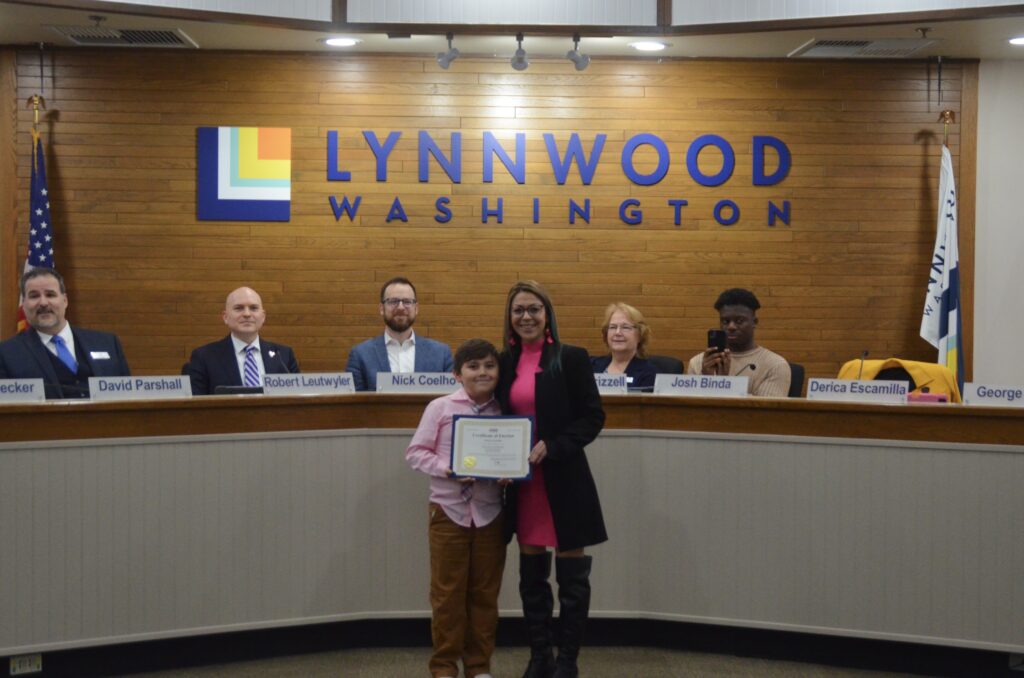
The meeting began with a proclamation for International Migrants Day (Dec. 18). The proclamation honored migrants in Lynnwood who left their home country and “helped build this city and its economy… through the major contributions of their work,” the proclamation read.

Fee increases
In a 4-3 vote, the Council approved a substantial increase to the City’s building permit fees. The ordinance includes a 14.7% fee increase across most permits and a 35% increase for major projects valued over $5 million. Councilmembers Robert Leutwyler, David Parshall, Nick Coelho and Josh Binda voted in favor and Councilmembers Derica Escamilla, George Hurst and Patrick Decker voted against.

City staff stated the goal is to achieve 100% cost recovery for development services, ensuring that development services aren’t paid for out of the general fund. When cost recovery is below that, money from the general fund is used to make up the difference, staff said. Lynnwood saw 88% cost recovery over the first three quarters of 2025, City Planning Manager Karl Almgren said.
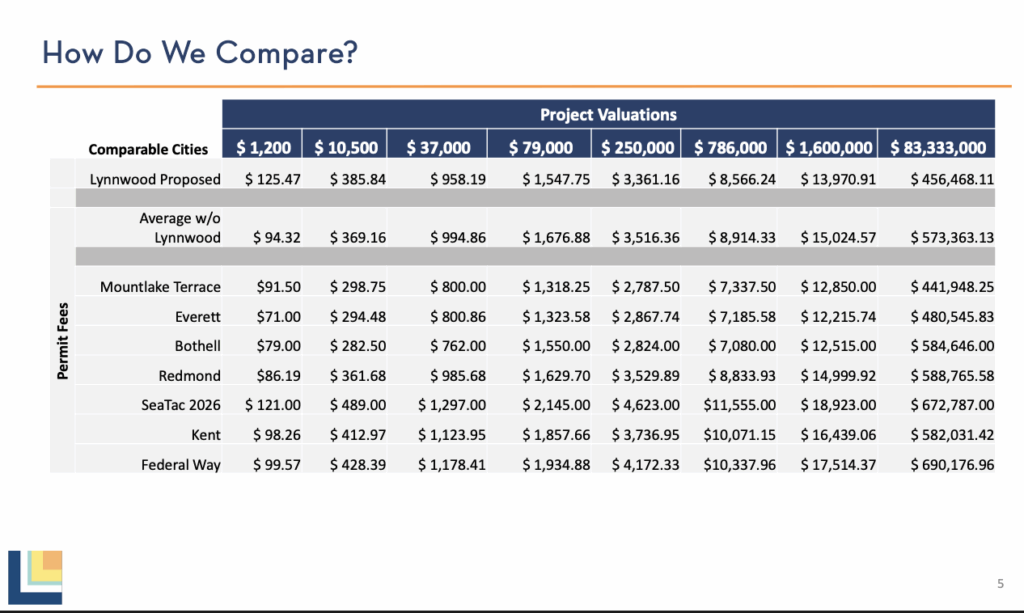
Based on the valuation of incoming projects in Lynnwood, the change is estimated to generate $537,000 and $2 million in 2026 (estimated valuation range of $188 million to $307 million), according to City documents.
With the increases, the City’s permit fees are average when compared to cities that staff deemed similar to Lynnwood (cities with similar population growth, current or future light rail and with large planned or completed redevelopment projects). Similar cities include Mountlake Terrace, Everett, Bothell, Redmond, SeaTac, Kent and Federal Way.
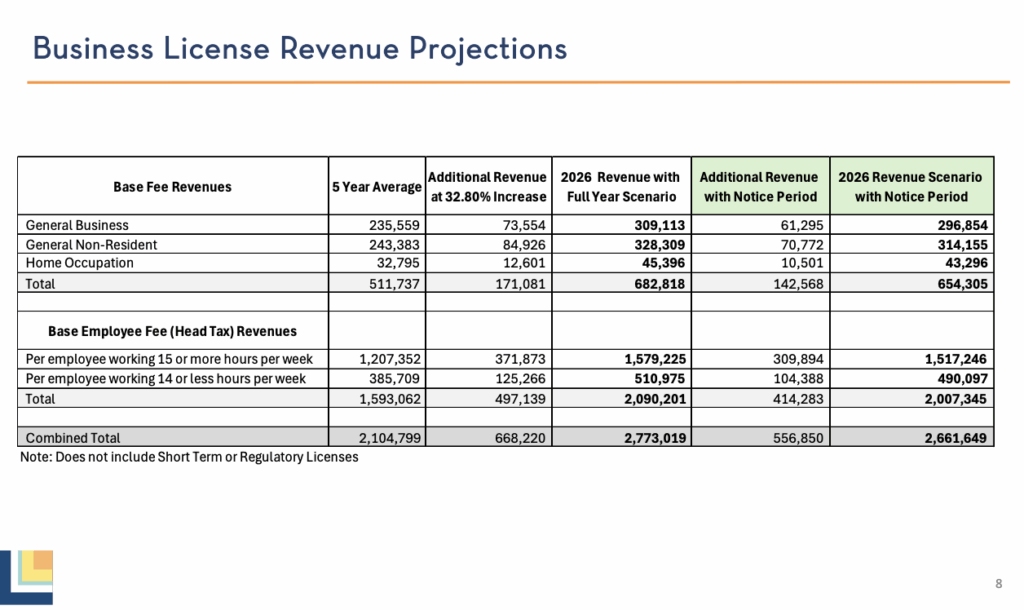
Additionally, the Council voted 4-3 to increase business license fees by approximately 33%, a rate that staff proposed to account for inflation from 2019. Councilmembers Decker, Hurst and Parshall opposed the measure.
Under the new ordinance, annual fees for general business employees will range from $64 per person working under 14 hours weekly to $124 per person working over 15 hours weekly. View a full list of business fees here.
The changes are estimated to increase revenue by $2.6 million in 2026.
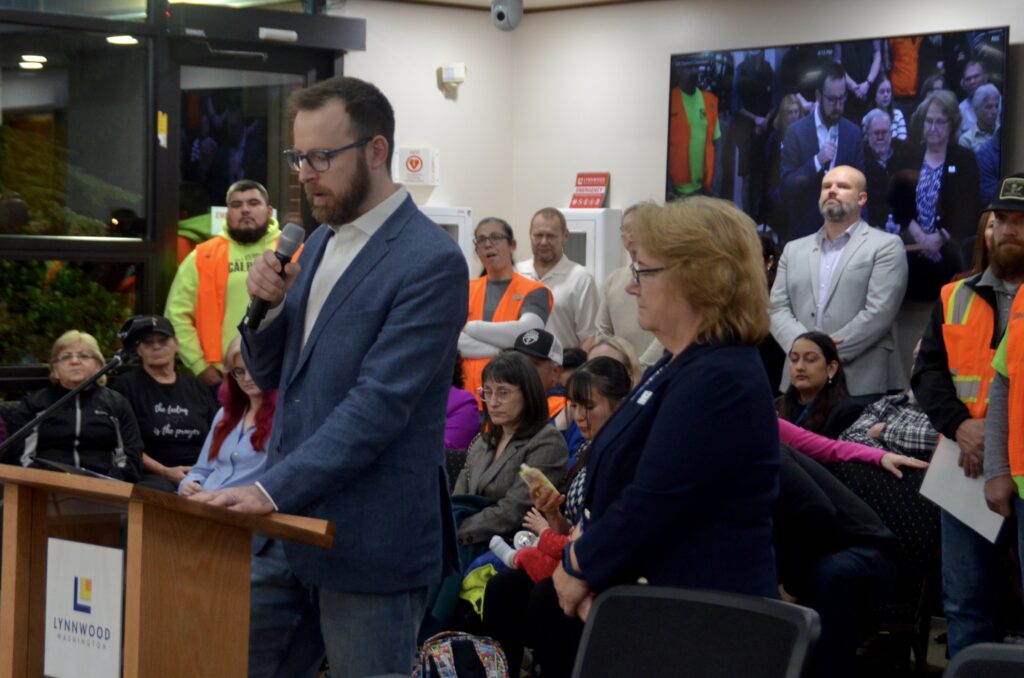
Before the Council passed the motion, Lynnwood Business Development Program Manager Simreet Dhaliwal-Gill reached out to local small businesses, ranging in size and industry. She said local business owners supported a reasonable, phased increase, but found a 33% increase to be “alarming.” Business owners surveyed said they want the City to review its spending before increasing fees, ensuring “reasonable budgeting went behind it,” Dhaliwal-Gill told the Council Monday.
Both measures will go into effect March 1, following a 75-day notice required by the Washington Department of Revenue.
Public safety tax
By a 5-2 vote, the Council also passed a resolution authorizing the mayor to prepare an ordinance imposing a 0.1% public safety sales tax. The tax, authorized by the state Legislature under House Bill 2015, is intended to fund criminal justice expenses, specifically aimed at maintaining police staffing levels. Councilmembers Binda and Escamilla voted against the measure. This vote does not put the tax into effect, it only authorizes the incoming mayor and Council to continue working toward the process of applying for the tax.
According to City documents, the City’s general fund faces a projected $4.8 million deficit in 2026, driven partly by a 44% increase in public safety costs since 2018. To begin collecting the tax by April 1, the City must pass an ordinance and deliver it to the Department of Revenue by Jan. 15.
However, the City can only collect the tax if it meets the qualifications for an associated grant program from the Washington Criminal Justice Training Commission. To qualify for the grant, jurisdictions must comply with immigration enforcement under the “Keep Washington Working Act”; adopt state-mandated use-of-force, de-escalation and firearm-relinquishment policies; complete mandated officer training, and report use-of-force data, per state law.
The Washington Criminal Justice Training Commission hasn’t approved any applications from 19 cities that applied to the tax so far, as they aren’t in compliance with the grant requirements, Lynnwood Police Chief Cole Langdon said Monday. The City closest to approval was Bellingham, he said, and Lynnwood is working closely with their department to mirror their application process.
Although it’s a competitive fund, Langdon said he felt confident in Lynnwood’s chances of approval.
“We believe it’s attainable,” he said. “It’s just such a new law and you have so many agencies that are now flooding to seek this opportunity just because they’re in a similar sort of dire situation.”
City leadership reorganization
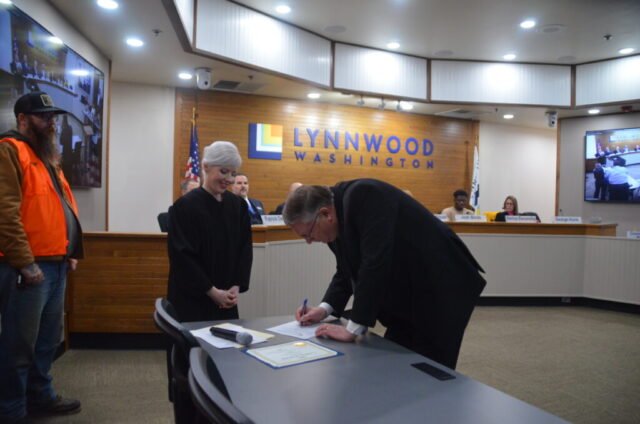
Monday’s meeting formalized the transition of power for the City’s new elected officials.
Three proclamations were issued to honor outgoing officials:
- Mayor Christine Frizzell: Elected as mayor in 2021 prior to election to City Council in 2017.
- Councilmember Josh Binda (Position 3): Elected in 2021. At 21 years old, he was the youngest African American to be elected to public office in Washington.
- Councilmember Patrick Decker (Position 5): Appointed to Council and subsequently re-elected in 2021. He chose not to run for re-election this year, instead taking office as a Snohomish County Charter Review Commissioner in January, serving District 3.

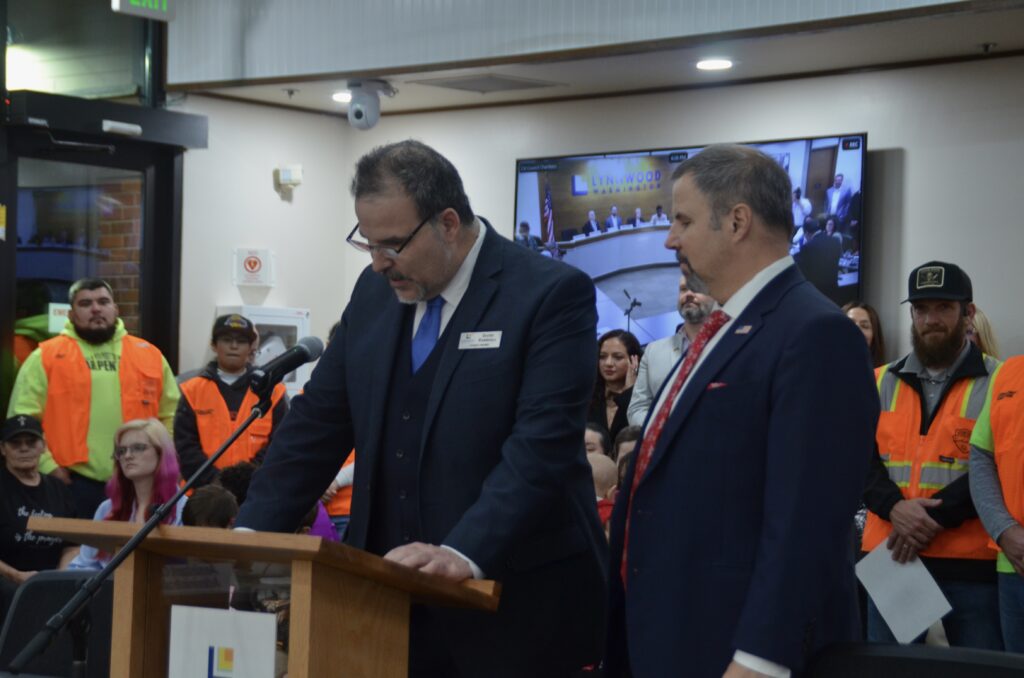
The following individuals were elected in November and are set to begin their terms Jan. 1:
- George Hurst, currently holding Council Position 6, took the oath of office to become the City’s next mayor for a four-year term. He was elected to Council in 2019.
- Derica Escamilla, elected to Position 1. She was appointed in 2024 after former Councilmember Shirley Sutton resigned.
- Isabel Mata, replacing Decker in Position 2 for a four-year term.
- Bryce Owings, replacing Councilmember Josh Binda in Position 3 for a four-year term.
- Robert Leutwyler, reelected to Position 5 for a two-year term, in accordance with state law. He was appointed to the Council in March after the resignation of Julieta Altamirano Crosby.
Gallery





With Hurst vacating his Council seat to become mayor, the Council voted to initiate the process to fill the vacancy for Position 6. Applications opened immediately with a deadline of Jan. 2. The Council anticipates interviewing finalists on Jan. 20 and appointing a new member by Jan. 26.
This will be the Council’s third time going through this process since the beginning of 2024, following the resignation of former Councilmembers Shirley Sutton and Julieta Altamirano-Crosby. The process involves the City Clerk publishing a notice of vacancy, followed by the Council reviewing applications and interviewing up to eight finalists.
Learn more about how to apply here.
Employee salary increases
The Council unanimously adopted the 2026 salary schedule for non-represented General Salary Ordinance (GSO) employees, authorizing a 2.7% cost-of-living adjustment (COLA), also known as an inflation adjustment. This is consistent with the COLA for unionized employees. The increase is estimated to cost the City an additional $329,000 for 2026.
Lynnwood Human Resources Director Annie Vandenkooy warned that failing to provide equal adjustments leads to wage compression, where supervisors earn nearly the same or less than the employees they manage. With over $12 million made in service and staff cuts in 2025, Vandenkooy said employees are working harder to fill the gaps without additional compensation.
The City’s pay philosophy is to not exceed or fall below the local average for City government employee pay by 5%. The increase keeps Lynnwood in this range, Vandenkooy said. Cities comparable to Lynnwood have an average annual COLA of 3%.
From 2020 to 2025, turnover for City employees was 12.5%, consistent with national averages. Lynnwood’s rate peaked at 17% in 2020, likely due to COVID, she said.
“Research shows that employees stay when they are mentored, challenged, promoted, included, trusted and empowered,” Vandenkooy told the Council.
Lynnwood’s non-represented employees include department directors and managers, City administrative assistant, the City Council executive assistant, lifeguards, the police chief and deputy, streets maintenance supervisors, janitors and facilities workers.
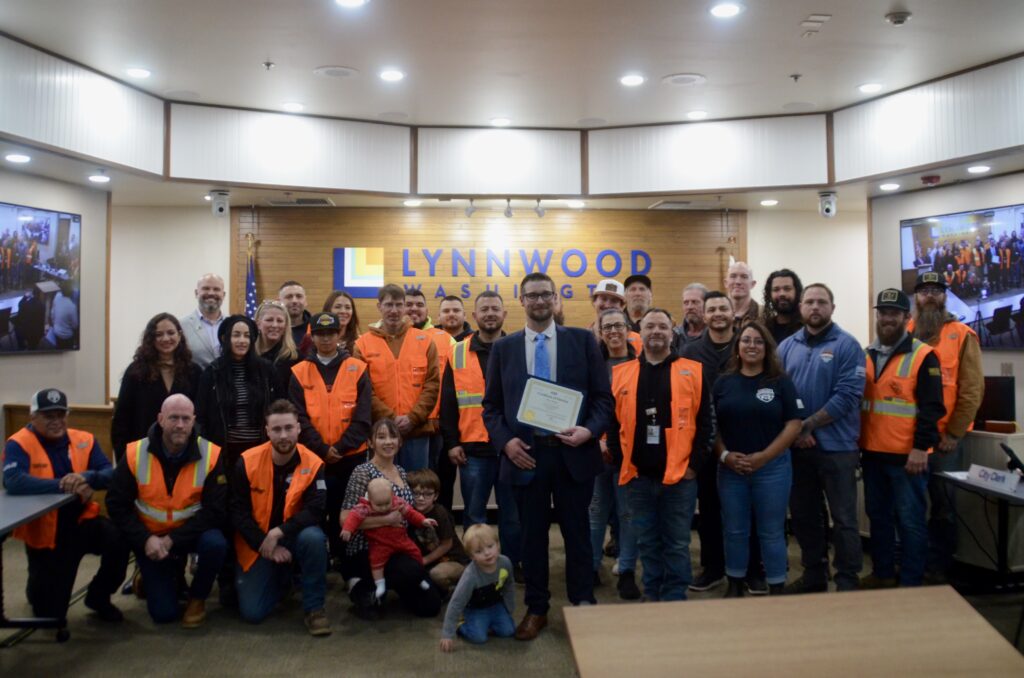
Dozens of current and former City employees gathered at the meeting to speak in-favor of the increase and to support their colleagues.
“We’re not just managers, supervisors, lifeguards, director assistants, custodians, facility staff,” Council Executive Assistant Estee Milburn said during public comments. “We are mothers. We’re fathers, sons and daughters, all working hard and doing our best to provide for those that we care about. As costs rise, we’re simply asking for the same recognition and consideration to help us keep doing that while serving this community.”
Animal control ordinance
In a late addition to the agenda, the Council voted 5-2 to adopt updates to the City’s updated animal control code. The ordinance clarified definitions regarding dangerous animals and added specific restraint requirements. Several amendments proposed by Escamilla regarding veterinary confirmation for euthanasia and the lowering of fines failed to pass. Councilmembers Binda and Escamilla voted against the final ordinance.
In 2024, Escamilla sat before the hearing examiner when after her police attempted to declare her dog as a dangerous animal after it attacked another dog that later died. The examiner partially granted Escamilla’s appeals.
The meeting recording and agenda are available on the City’s website.
— Contact Ashley at ashley@myedmondsnews.com.


Real first and last names — as well as city of residence — are required for all commenters.
This is so we can verify your identity before approving your comment.
By commenting here you agree to abide by our Code of Conduct. Please read our code at the bottom of this page before commenting.