
Will you chip in to support our nonprofit newsroom with a donation today? Yes, I want to support My Lynnwood News!
Lynnwood is Snohomish County’s commercial nucleus. The city is nestled between two major interstates, halfway between Seattle and Everett and is now the end of the Link light rail line. Alderwood Mall, one of the largest in the region, is thriving in an era of dying malls. Despite this, many say the city lacks a heart – a central downtown core to bring the community together.
For decades, both public and private entities have sought to change this, including the Lynnwood Public Facilities District (PFD). The PFD aims to transform Lynnwood from “a place with a mall” –as the city’s Reddit forum puts it– shifting the city from “gray to green” into the “heart of Lynnwood.”
The project is known as “The District.”
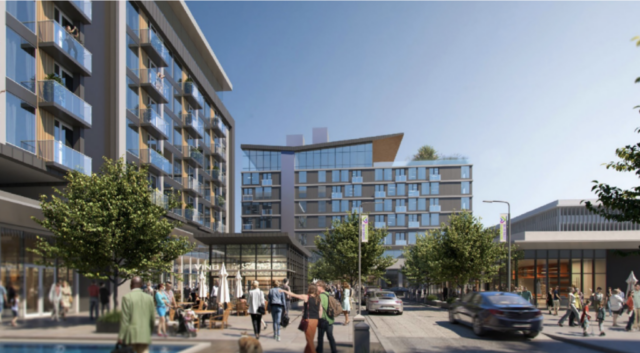
Drawing inspiration from nearby centers, including Seattle’s University Village and downtown Bothell, The District is designed as a cohesive downtown initiative on the publicly-owned Lynnwood Event Center’s 13-acre campus. The project will replace nine acres of existing single-story commercial buildings with mid-rise, mixed-use facilities, including housing, a hotel, an upgraded event center, expansive green space and improved pedestrian and transportation infrastructure.
Since completion of the Lynnwood Event Center in 2005, the PFD’s plan was to eventually develop the site into a downtown center, Lynnwood Public Facilities District Executive Director Janet Pope said in an interview with Lynnwood Today. However, repeated economic crises, including the pandemic and the 2008 recession, pushed the dream further down the road. Finally, despite ongoing national economic struggles, the PFD is confident that now is the time to bring The District to life, Pope said.
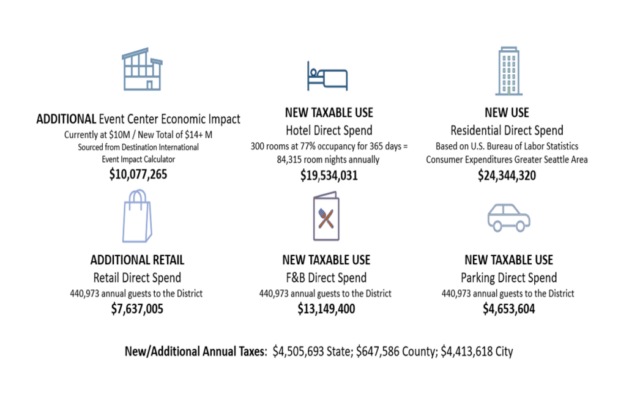
The project is estimated to create more than 800 jobs and generate nearly $80 million in direct economic impact. Pope said public response has been largely positive; About 79% of residents responding to a recent community survey say they view The District favorably.
At the request of the PFD, the Lynnwood City Council last week approved measures to advance the project. These include the project’s master plan, development and road construction contracts. The council also approved a short-term financing plan backing the PFD in a securing $15 million loan from the Snohomish County Treasurer’s Office.
While a final cost estimate won’t be solidified until after the design process begins, the entire project is estimated to cost around $500 million, Pope said. The PFD’s portion of costs sits at around $200 million for the event center, plaza, a parking garage and street construction. It’s estimated that private developers will cover the remaining $300 million for retail and residential construction.
The City of Lynnwood is facing an estimated $11.8 million deficit in its 2025-2026 general fund budget. At recent City Council meetings, residents expressed concern and confusion over the city’s decision to enter major projects after cutting over $11 million in staff and services in recent months.
However, Pope said the PFD carefully designed the project so there is no cost to the city. Thanks to tax financing measures the City passed earlier this year, construction won’t advance until funding is in place, city staff confirmed at an October Council meeting.
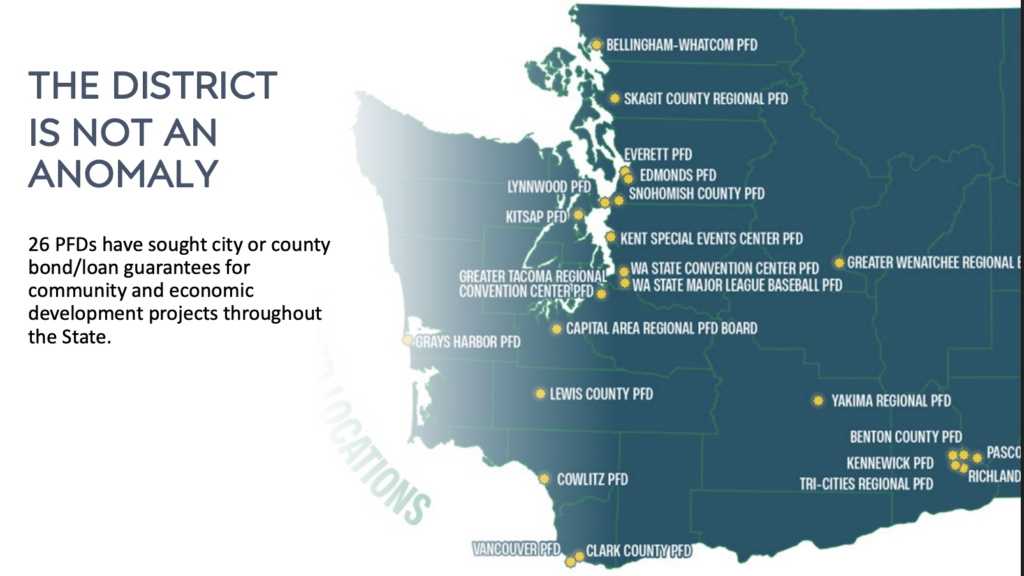
T-Mobile Park in Seattle was Washington’s first quasi-municipal public facilities district. This sparked a legislative move to designate similar districts statewide. PFDs are “municipal corporations” and tax districts within a jurisdiction. PFDs are allowed to use taxes to “develop, improve and operate ‘regional centers’” and “develop and operate sports, entertainment, convention, or recreational facilities,” according to the Municipal Research and Services Center.
Event center expansion
Central to the project is the significant expansion of the Lynnwood Event Center. The existing event center, completed in 2005, is about 64,000 gross square feet and will be expanded by about 119,000 square feet, effectively “doubling the size of the event center,” Pope said.

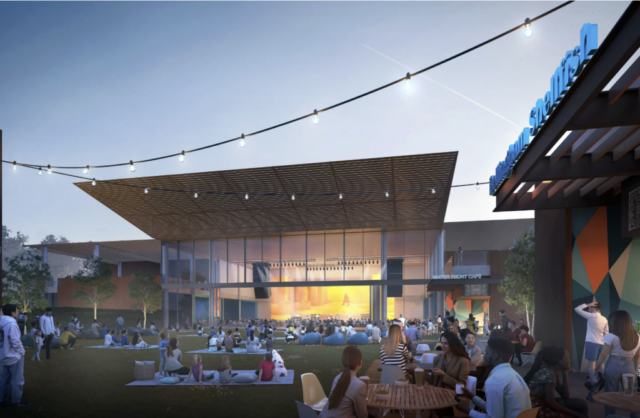
The expanded facility is forecast to host 90 to 139 events annually. Currently, the event center’s largest room holds 1,200 people. The expansion opens the possibility of hosting a 2,000-person event indoors, and up to 2,500 people with the integration of an outdoor venue, thanks to a mobile stage that so far is available in only a few venues nationwide. For outdoor events, the stage will sit at the ground level. Lowering the stage underground into the event center transforms the facility into a theater in 30 minutes for indoor events.
The District is intentionally positioning itself to attract events that do not compete with larger regional facilities like the Angel of the Winds Arena or smaller venues like the Edmonds Center for the Arts. The expansion is planned to be the “right size for Lynwood,” filling the gap for mid-sized events, Pope said.
Given the proximity of new residential buildings, both onsite and adjacent, and the plan for live indoor/outdoor music concerts, noise mitigation is crucial. Outdoor concerts are expected to occur mainly on Fridays and Saturdays, beginning at approximately 7 p.m. and ending no later than 10 p.m., Pope said.
The PFD also plans to construct a 32-foot wall and position the two residential buildings in a way that blocks sound from seeping into nearby neighborhoods. It must implement a Sound Monitoring Plan, per state law, installing monitoring systems and ensuring sound engineers are present at all outdoor concerts to monitor sound at live events.
Housing and hospitality.
A major component of The District is the construction of two five-story residential buildings. These buildings will offer around 408 units, based on the most recent analysis. The focus is on providing workforce housing, specifically targeting the 60% to 80% Area Median Income (AMI) range.
“I really want to be able to tell the story that the people who work and live in Lynnwood, particularly our hospitality staff, can afford to live here,” Pope said.
The project’s development agreement caps maximum building height to 35 feet for any portion of a building within 100 feet of a residential zone. Beyond that residential setback, buildings can be up to 100 feet tall.
A proposed 300-room hotel is seen as a crucial piece of the project, addressing the historical difficulty of attracting national convention guests due to a lack of on-site accommodation, Pope said. The goal is an elevated experience: a “boutique hotel” with “nice lobbies and [a] nice rooftop bar,” she said.
However, the hotel is planned on the site of the former Alderwood Laundry and Dry Cleaners, which requires significant soil and groundwater cleanup. The PFD secured $2.8 million in county financing to address contamination that had previously deterred hotel partners from building on the property. The cleanup is state-mandated before the City begins construction on the nearby 38th Avenue public right-of-way, according to project documents.
Retail and public space
The plan includes up to 151,000 square feet of retail space, focusing on curation and local identity and prioritizing leases that support local merchants, Pope said.
Through community surveys, the district is soliciting input on residents’ favorite local restaurants and shops to fill the retail space.
“This will be what really represents local retail,” she said.
The PFD intends to retain current tenants, including Olympus Spa and Kona Kitchen, despite potentially increased rents and the need to “weather the construction period,” Pope said.
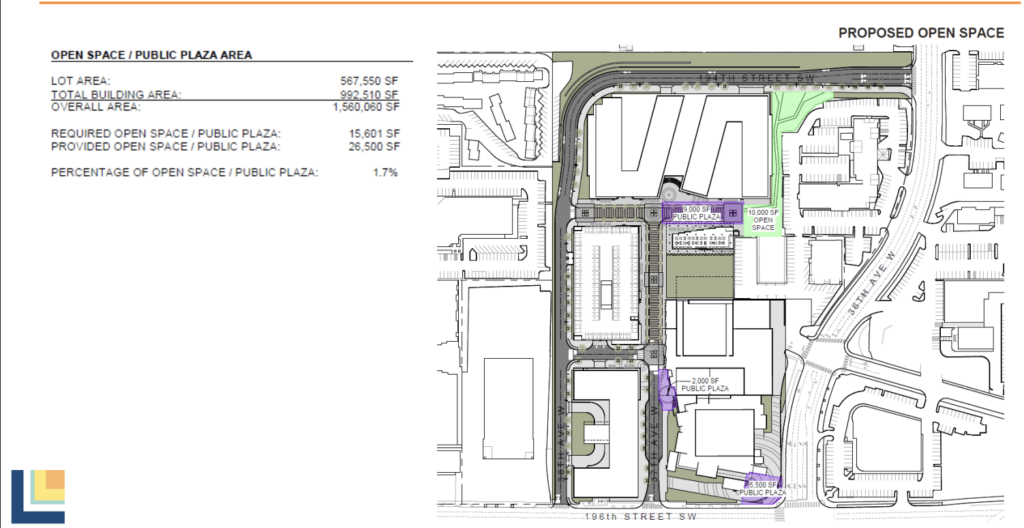
The District is committed to fulfilling the community’s desire for public space and walkability with plans to convert acres of parking lots into usable green space and public areas.
A proposed “woonerf street” – Dutch for “living street” – is a festival street envisioned as a location for pop-up food and art exhibitions. It could also host a weekly farmer’s market with an emphasis on local merchants and Snohomish County farmers, Pope said.
In addition, the proposed lawn/plaza area seeks to serve as an “everyday open space,” Pope said. It would be available for community use, but also tailored for special events such as outdoor yoga, concerts, movie nights and a winter ice rink, and a potential splash pad for the warmer months.
Costs, construction and logistics
The total development timeline is expected to be about five years once groundbreaking commences in 2027. The plan calls for the project to be phased to maintain current operations for as long as possible.
Project documents detail a potential phasing timeline:
- Phase 1: Demolition, site remediation, road construction
- Phase 2: Housing
- Phase 3: Event center, parking garage, retail and public spaces
- Phase 4: Hotel
The project is set to enter the schematic design phase in early 2026. This follows the current conceptual design phase, involving the development agreement, financing and environmental reviews.
Pope said the PFD operates independently from the city and can repay its loans without using city money. The PFD’s share of the project will be financed through district bonds, county loans and about $10 million in city tax increment financing the Council approved earlier this year.
For the conceptual phase, the PFD received $3 million total from the state. To fund the schematic design, the PFD is seeks a $15 million loan through the Snohomish County Treasurer’s Community Investment Program, backed by the city through recent council approval.
While the County loan requires the City of Lynnwood to provide credit backing, officials with The District emphasized they are financially capable. At a Council meeting last week, Lynnwood Finance Director Michelle Meyer said cities often back PFD loans; Lynnwood did so for $30 million in bonds for the event center in the 2000s, with no missed payments. The bond will have no impact on the city’s ability to issue its total $70 million in bond capacity, Meyer said.
A state financial feasibility review determined the PFD has the “wherewithal to pay this loan without ever imposing on the city,” city documents say.
The PFD plans to use the $15 million County loan to:
- Pay off its remaining $9.6 million of debt from the construction of the 2005 event center;
- Advance schematic design with $2.8 million, honing in on design elements to cement true project costs;
- Use $2.8 million to clean up the hotel site;
- Give the City $400,000 for the PFD’s portion of road design costs.
Parking and transportation
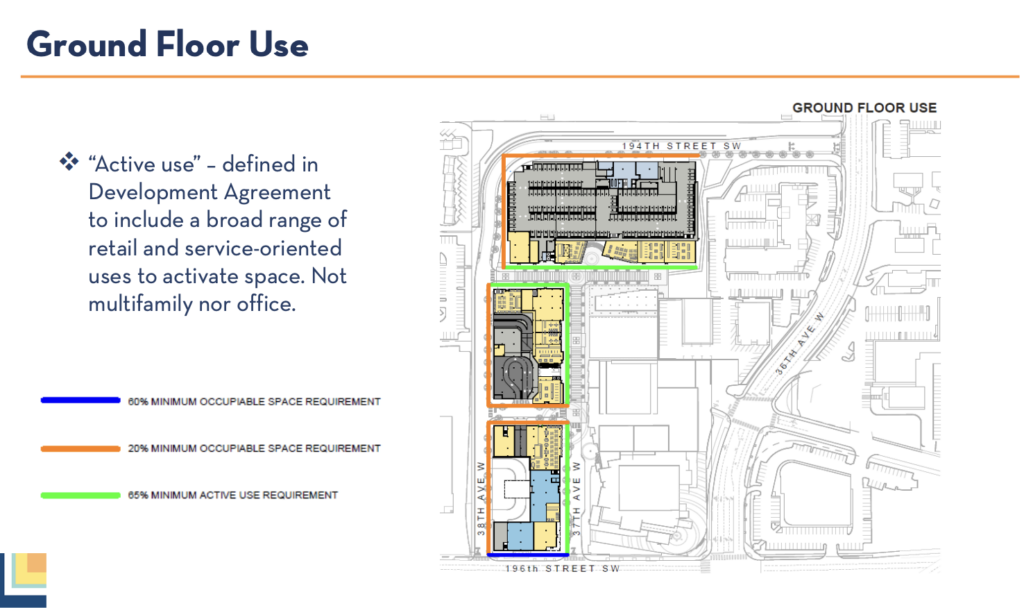
The plan includes 1,030 parking stalls that includea 550-stall parking garage, with a portion of stalls reserved for residents and hotel guests. The structure will be “wrapped in retail, so you won’t even know there’s a parking garage there,” Pope said. It will include designated spots for rideshare pickup and dropoff, directing traffic away from nearby streets, she added.
Peak demand for large events is estimated at around 800 vehicles. To balance demand, the development agreement also permits offsite parking up to half a mile away from the property.
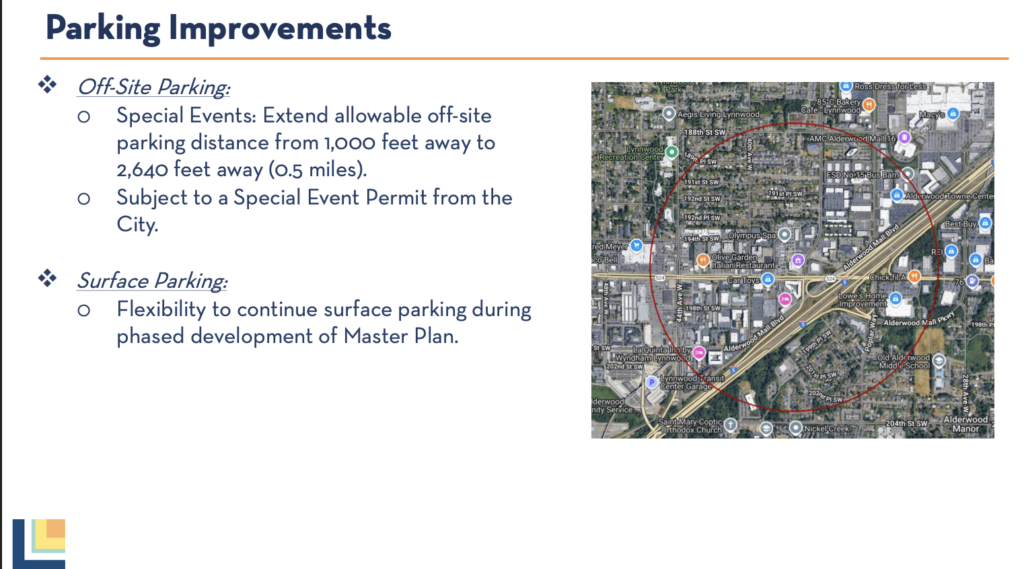
To address resident parking concerns, the City is considering creation of a Residential Parking Zone, which would mean issuing permits for residents to prevent attendees from parking on neighborhood streets.
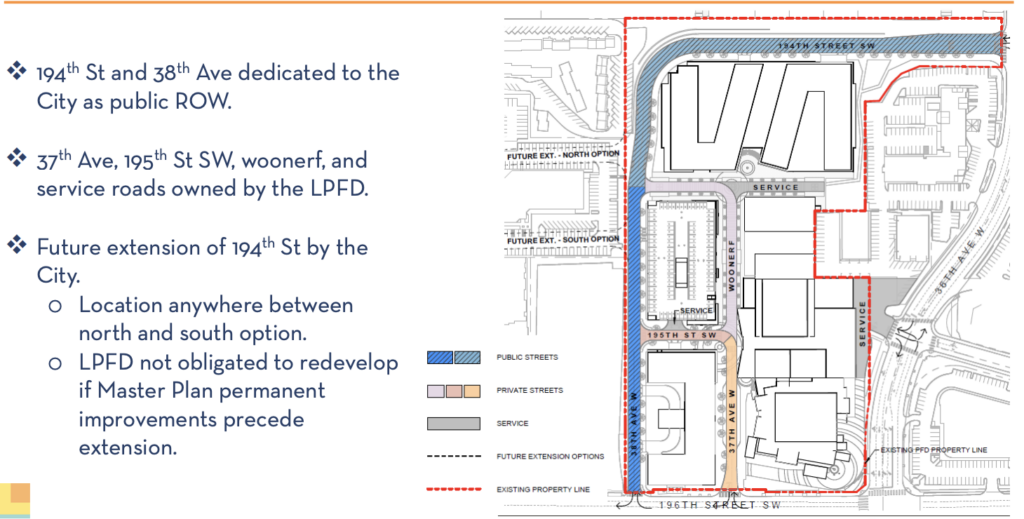
The project also contains plans to build a new “ring road” public right-of-way, comprising 194th Street Southwest and a new 38th Avenue West, which will “ring the perimeter of the redeveloped mixed-use buildings,” Pope said. This roadwork is necessary because the retail and housing components require road frontage.
A traffic signal is also slated for the future intersection of 194th Street Southwest and 36th Avenue West once 25% of the PFD Master Plan is developed. The signal is expected to be installed by the City as part of a project to expand 194th Street Southwest, Pope said.
— Contact Ashley at ashley@myedmondsnews.com.


Real first and last names — as well as city of residence — are required for all commenters.
This is so we can verify your identity before approving your comment.
By commenting here you agree to abide by our Code of Conduct. Please read our code at the bottom of this page before commenting.