
Will you chip in to support our nonprofit newsroom with a donation today? Yes, I want to support My Lynnwood News!
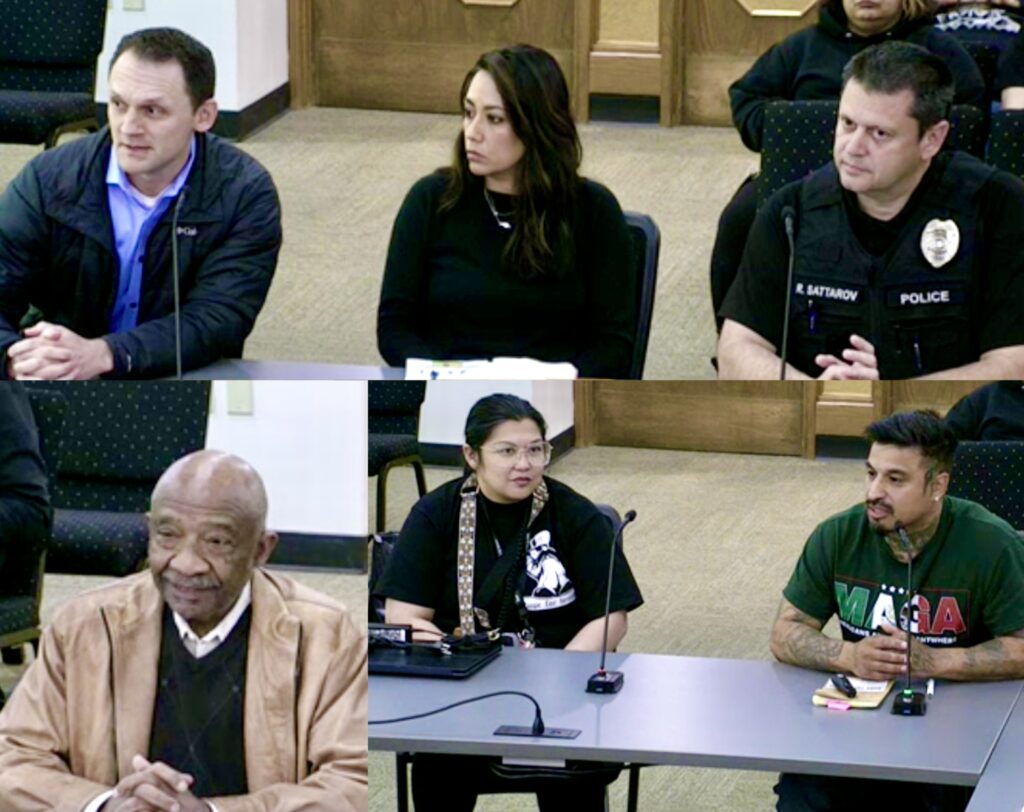
The Lynnwood City Council met Wednesday to discuss youth violence and gang violence in the city, hearing from police and community leaders dedicated to supporting youth through hardship.
Jose “Neaners” Garcia, representing local nonprofit organization Hope for Homies, was among those leaders. He came to the council with a message about youth feeling unseen and the consequences of that isolation and misunderstanding.
“If young people don’t feel a part of the village, they will burn it down to feel its warmth,” he said. “And that’s what’s happening in our community. Our kids are not being seen. They’re being targeted, but they’re not being seen. There’s a difference. There’s a difference in that.”
Representing the Lynnwood Police Department at the special business meeting were Cmdr. Justin Gann, Det. Russ Sattarov and Crime Analyst Olivia Curran, who provided an overview of recent statistics.
Sattarov presented data, emphasizing the gravity of the situation.
“There’s no happy numbers here… youth violence is what it is,” he said. “There’s no winners and there are fatalities and there are injuries and long-term implications.”
Key findings from the Snohomish County Child Fatality Review (2023-2024) focused on homicides:
- 63% were gang-related cases.
- 40% involved youth actively trying to leave gang life.
- 50% of homicide victims witnessed prior acts of violence, including domestic violence.
- 60% had families seeking support for gang exit.
- 100% of gang-related cases involved social media threats.
Gang members in the region are predominantly between the ages of 13 and 20, and in Lynnwood have an average age of 15-16. Most prevalent violent gang activities include drive-by and attempted assaults, along with robberies, assaults and homicides. These statistics specifically exclude minor offenses like shoplifting,
Lynnwood-specific data on case reports involving juveniles showed an increase from 161 in 2022 to 336 in 2024, with 93 reported through April 2025. Juvenile arrests and referrals to outside organizations also rose from 119 in 2022 to 270 in 2024, with 76 through April 2025. Sattarov noted the increase in arrests reflects the focus on violent crimes, “Hence, because those are violent crimes, you’re going to have more arrests rather than maybe referrals to schools,” he said.
The department also presented data on school-related case reports and calls for service, comparing periods with and without School Resource Officer (SRO) programs. Significant increases in case reports and calls for service were noted at some middle schools, particularly Meadowdale Middle School – with a 280% increase in case reports from 2018-2020 under the SRO program, to 2022 to 2024 without the program.
In 2020, Edmonds School District voted to remove officers from high schools in the district following the death of George Floyd earlier that year at the hands of Minneapolis police and calls from the community to take police out of schools. Board members at the time emphasized hearing stories from students of fear and trauma associated with law enforcement, specifically for students of color.
Sattarov expressed his opinion on school resource officers, highlighting their role in police investigations and connecting with families seeking help for their children involved in gangs or other issues.
“When we show the numbers of parents who are telling us, ‘we want to speak to the police, we want to ask for additional help’… that’s probably even more important when they can go to school resource officers and discuss something with them directly,” Sattarov said.
Regarding how the police address youth violence, Sattarov described an individualized approach, working closely with schools and families to determine helpful interventions.
“We work with that family individually to see what they might consider helpful in getting their kids off the streets, back at home, back into school,” he said. He mentioned repeatedly talking with youth, visiting them and helping connect them with academic assistance or resources for those struggling with substance use.
When councilmembers asked about contributing factors to a spike in juvenile crime between 2023 and 2024, Lynnwood Cmdr. Gann suggested it could be due to legislative changes “on how police can interact and handle juveniles,” and “unfortunately social media.”
Lynnwood Police Chief Cole Langdon said the city can help address gun violence in Lynnwood by continuing to support the department through initiatives like the city’s gun buyback program, which had been funded through the American Rescue Plan Act.
Councilmember Derica Escamilla commended the police department’s engagement with elementary schools, noting the impact on children’s perception of law enforcement at a young age.
“It’s when they’re little that it matters. Middle school is too late is what I’m hearing,” she said.
Then, the council heard from Garcia, who spoke about the work “Hope for Homies” is doing to reach youth and other people in and around Snohomish County.
“Our whole goal is always to find out what the basic needs are,” he told the council. “And we’re never going to be able to get them if we don’t have community and if we don’t have self-realization and if we don’t have social skills.”
Headquartered in Stanwood, Hope for Homies offers programs that include a youth group, low-cost tattoo removals and reentry support for people who were incarcerated. Additionally, the organization provides job opportunities for teen mothers and others needing employment.
Garcia shared his personal journey – describing how he was exposed to violence and hardship as a child, and first being arrested at age 10. Garcia was again arrested at age 14 and spent 19 years in prison, 12 of those in solitary confinement, he said.
He explained the Hope for Homies’ origin, stemming from his experiences attending numerous funerals of youth in the community and translating for Spanish-speaking families impacted by youth violence.
Hope for Homies is not a traditional “gang prevention program,” he said. “We’re a healing center.”
Garcia said the organization works with the Tulalip Tribe on a diversion program to target youth in those communities who need substance abuse treatment or other support. The group also uses unconventional treatment methods such as equine therapy. Additionally, they offer a program called “Hoods in the Woods” aimed at broadening youth perspectives beyond their immediate neighborhoods. They also work to connect youth with educational opportunities, partnering with colleges to secure funding for tuition.
Wally Webster, president of The ACCESS Project (Association for Collective Community Engagement on Safety and Security), provided an update on his organization’s efforts. Webster has been engaged in the community for multiple decades, Mayor Christine Frizzell said, noting his work with youth and in community healing.
Webster said the ACCESS Project originated from community discussions about safety and a desire to take action following the death of 13-year-old Jayda Woods in 2024.
“I had no idea what I was getting into,” he said. “I did not know the severity of the issues that [were] faced in our community… but I do know one thing: We are determined to be a part of the solution, opposed [to being] to part of the problem.”
Webster said the organization’s mission is to be proactive and “get in front of the behavior that our youth are facing,” to identify early warning signs and underlying causes to prevent involvement in gun violence, criminal behavior, and self-harm. The group also partners with the Edmonds and Everett School Districts to connect youth directly to services and support.
Webster said many youth facing these issues are ethnic minorities. Although there are many “excellent” local organizations that work with youth, they often “work in their own silos… They don’t reach across and try to help each other,” Webster said.
“As a result of that, the youth do not know how to navigate to get the help that they need.”
The ACCESS Project’s programs address root causes such as unsafe living conditions, low self-esteem, unrealistic peer expectations, loneliness and bullying, Webster said. The group’s programs include:
- COPs vs. Youth Basketball Games: This program was designed to build trust and communication between law enforcement and youth, serving as an “interim of the Student Resource Officer to build that trust and that confidence,” Webster said. This aims to help youth build personal relationships with law enforcement, making it less intimidating for them to reach out in times of need, he said.
- Peer Mediation Program: A program training high school students on skills to mediate conflicts among their peers. Webster is now working on a pilot program for middle schools, finding that “majority of the problems start in middle school before they ever get to high school”.
- Arts and Therapy/Poetry Program: A program using creative expression to help introverted youth communicate their experiences and challenges.
Webster said attempting to help youth can often be an uphill battle.
“I didn’t realize the competition that we would have with gangs in trying to reach these youth who are being persuaded by gangs,” he said.
He called on the council to continue supporting the ACCESS Project and similar organizations, connecting them with community resources, fostering open communication with youth, and referring youth to their programs.
More broadly, he urged elected leaders from the city and school boards to “come together… and not work as a city government, not work as a school board, but work as leaders in the community focused on how we can help our youth.”
He also suggested city employees could serve as mentors and role models for young people.
“What I was passionate about is giving the youth the opportunity to have a voice in our city government and giving them the opportunity to make recommendations to the council,” he said.
A full recording of the meeting can be found on the city’s website.
— Contact Ashley at ashley@myedmondsnews.com.


So good to see so many reaching out and contributing to help solve the issue. Actual public safety and tracking of incidents, new tactics outside the silo!!
Hope you track the results of youths leaving the peer pressure of the gangs for skills, and careers. Thank you so much for those coming forward to make a real difference improving the lives of all within the community.