
Will you chip in to support our nonprofit newsroom with a donation today? Yes, I want to support My Lynnwood News!
Key takeaways:
- The Council authorized the mayor to sign an agreement with Sound Transit to reserve the City Center Station site for a farmers market planned for spring 2026.
- Public hearings were held on budget amendments and 2026 property tax levies.
- The council approved 2026 legislative priorities focused on securing Poplar Way Bridge funding, addressing jail medical costs, and improving public defense resources.
- Councilmembers adopted code updates clarifying development and parking standards and formally reaffirmed a pause on the city’s use of Flock license plate reader cameras.
The Lynnwood City Council at its Nov. 10 meeting approved a contract with Sound Transit, the first step in creating a Lynnwood farmers market slated for spring 2026. The council also voted on updates to city code, reviewed 2026 state legislative priorities and held four public hearings on matters including the City’s budget and 2026 property tax levies.
Public hearings
The Council held four public hearings on the following matters:
Mid-biennial budget review: The council conducted a routine, state-mandated public hearing on the City’s mid-biennial budget review. The review includes proposed changes to the budget that weren’t foreseen when it was adopted at the end of 2024.
Key proposed changes include additional funding for the legal department to cover rising prosecution and indigent defense costs, totaling about $351,000, and a $63,285 IT grant with no net fiscal impact. Vehicle replacement cycles for several departments would be extended, saving the general fund roughly $1.3 million.
Other adjustments include increased cost allocations from the city’s utility and golf funds, an additional $10,000 for lodging tax fund contracts, and the creation of a new Tax Increment Financing District fund. The police department’s Criminal Justice Fund would grow by $3.6 million to reflect new grants and program costs, while the Opioid Settlement Fund would add about $567,000 for human services and public health initiatives.
An accounting change in how shared technology expenses are managed will move $1.4 million in IT service costs into the Technology Replacement Fund. Several interfund transfers are also included to align restricted revenues with their intended uses.
The council will continue its review Nov. 17 and is expected to adopt final amendments on Nov. 24.
2026 property tax levy: For the 2026 property tax levy public hearing, City Finance Director Michelle Meyer provided an overview of the City’s property tax structure. The City’s regular property tax levy for 2025 totaled $7.2 million, based on an assessed valuation of $10.8 billion ($0.67 per $1,000 assessed valuation).
Under state law, the City can collect up to $11.6 billion in 2026 at an estimated rate of $0.95. If the City does so, this could increase the average homeowner’s property taxes by $209 annually, to around $644.
Meyer said the city gets $0.08 for every dollar of property taxes collected. Lynnwood’s tax rates are lower than most neighboring cities as the City has not increased taxes in previous years to collect the full levy amount allowed under state law.
During discussion, Councilmember George Hurst noted that previously established utility rates for 2026 show planned increases of 5% for water, 4.25% for stormwater, and 21% for sewer. Mayor Christine Frizzell said this was to help pay for necessary upgrades at the Lynnwood Wastewater Treatment Plant.
Planning and capital improvement updates: The council also held a hearing on the 2025 Comprehensive Plan amendment list and the Capital Facilities Plan (CFP)/six-year Transportation Improvement Plan (TIP).
Community Planning Manager Karl Almgren and Senior Planner Catherine Kato detailed two staff-initiated amendments to the Comprehensive Plan: one covering miscellaneous changes, including incorporating the annexation of the old Alderwood Middle School property and references to the new Unified Development Code; and the second formally adopting the new 2027-2032 Capital Facilities and Transportation Improvement plans into the plan’s appendix. The Planning Commission recommended approval of both items, Almgren said.
City Engineer David Mach and Civil Engineer Dylan Majewski presented the 2027-2032 Capital Facilities and Transportation Improvement Plans. They clarified that the Capital Facilities Plan is a non-fiscally constrained list of desired capital projects. These are updated annually, as required by state law, and help the city identify projects for grants. The document outlines 104 projects across five categories with a total estimated expense nearing $404 million. Regarding the Transportation Improvement Plan, staff noted plans to hire a consulting firm in early 2026 to study alternatives to alleviate traffic congestion at an intersection near the Costco on 33rd Avenue West.
Farmers market agreement: The council also authorized Mayor Frizzell to sign an agreement with Sound Transit allowing a $5,000 refundable deposit to reserve the Lynnwood City Center Station site for a proposed Farmers Market. The arrangement, negotiated by the Lynnwood Chamber of Commerce, would permit the market to use the property at no cost in exchange for sponsorship recognition. Although the agreement was approved, Council President Nick Coelho said there are still negotiations that need to happen before the project can move forward.
2026 legislative priorities: Additionally, the council adopted its 2026 state legislative priorities and policy statements. Assistant City Administrator Julie Moore noted that staff removed a positive message regarding the Flock camera system from the list of priorities. This was due to council concerns and the police department’s pause on the technology last week.
Key priorities adopted include advocating for the state to maintain a $10 million allocation for the Poplar Way Bridge and seeking an additional $5 million to cover rising project costs. The priorities also emphasize reducing the financial burden of jail medical costs and increasing funding for public defense to meet required caseload standards.
Code update approval: In addition, the council approved a miscellaneous code update ordinance, which revised sections of the Unified Development Code to clarify rules around driveway length, vehicle and bicycle parking, and related definitions.
In new business, the council voted to formally recommend continuing the pause on the city’s use of the Flock Automated License Plate Reader (ALPR) cameras until a full review is completed by early 2026. Council President Coelho cited concerns that the system was not meeting state transparency standards or community expectations for data security. The vote affirms a pause already in place by the Lynnwood Police Department.
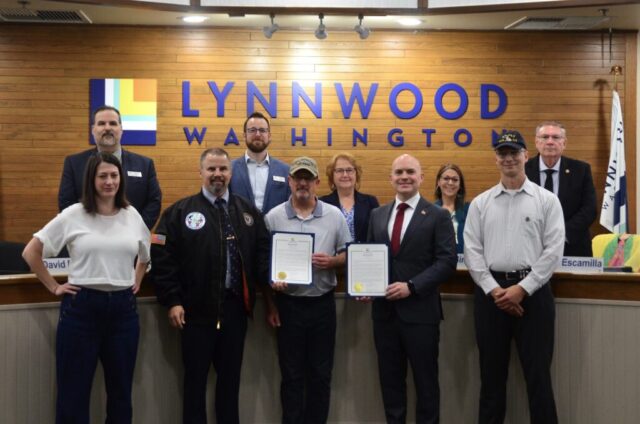
In other business, the meeting began with a proclamation for Veterans Day and the Council approved the appointment of Linda Finkle to the city’s History and Heritage Board. Finkle, who has a background in writing and marketing, said she hopes to help make Lynnwood’s history “informative, exciting, inclusive and easily accessible.”
The meeting agenda and recording can be found on the City’s website.
— Contact Ashley at ashley@myedmondsnews.com.


Cancel sthe FLOCK program and get our money back. According to an article in the Seattle Times on 12/18
“In her Nov. 6 ruling, Judge Elizabeth Neidzwski said the cities of Sedro-Woolley and Stanwood could not deny an Oregon man’s public records requests for Flock photos and data because they qualify as public records and can’t be exempt from release under the state’s Public Records Act.”
Please review our contract with FLOCK and get our money back. I can’t recall how much it was, but it was significant. Lynnwood needs all the money it can get to avoid increasing property taxes and utility rates.