
The Social Security Administration announced a 2.8% boost to monthly Social Security and Supplemental Security Income (SSI) benefits for 2026, another rate drop versus last year’s increase of 3.2%. The increase is based on the rise in the Consumer Price Index over the past 12 months ending in September 2025.
For those contributing to Social Security through wages, the potential maximum income subject to Social Security taxes is increasing to $184,500. This represents a 4.8% increase in your Social Security taxes. What’s of interest here is the continued practice of raising the income subject to Social Security well beyond the annual Consumer Price Index. Here’s a recap of the key dollar amounts:
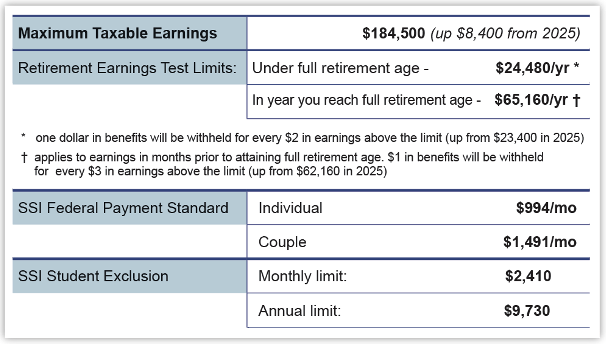
2026 Social Security Benefits – Key Information
What it means for you
- Up to $184,500 in wages will be subject to Social Security taxes, an increase of $8,400 from 2025. This amounts to $11,439.00 in maximum annual employee Social Security payments (an increase of $521), so plan accordingly. Any excess Social Security taxes paid because of having multiple employers can be returned to you as a credit on your tax return.
- For all retired workers receiving Social Security retirement benefits, the estimated average monthly benefit will be $2,071 per month in 2026, an average increase of $56 per month.
- SSI is the standard payment for people in need. To qualify for this payment, you must have little income and few resources ($2,000 if single, $3,000 if married).
- A full-time student who is blind or disabled can still receive SSI benefits as long as earned income does not exceed the monthly and annual student exclusion amounts listed above.
Social Security and Medicare Rates
The Social Security and Medicare tax rates do not change from 2025 to 2026. The rates are 6.20% for Social Security and 1.45% for Medicare. There is also a 0.9% Medicare wages surtax for single taxpayers with wages above $200,000 ($250,000 for joint filers) that is not reflected in these figures. Please note that your employer also pays a 6.2% Social Security tax and a 1.45% Medicare tax on your behalf. These amounts are reflected in the self-employment tax rate of 15.3%, as self-employed individuals pay both halves of the tax rate.
 Nancy J. Ekrem, CPA
Managing Shareholder
DME CPA Group PC
Certified Public Accountants & Business Consultants
nekrem@dmecpa.com

Real first and last names — as well as city of residence — are required for all commenters.
This is so we can verify your identity before approving your comment.
By commenting here you agree to abide by our Code of Conduct. Please read our code at the bottom of this page before commenting.