
Will you chip in to support our nonprofit newsroom with a donation today? Yes, I want to support My Lynnwood News!
This is the eighth and final installment of Edmonds resident Nathaniel Brown’s recent travels to Greece. You can read part 1 here, part 2 here, part 3 here, part 4 here, part 5 here, part 6 here and part 7 here.
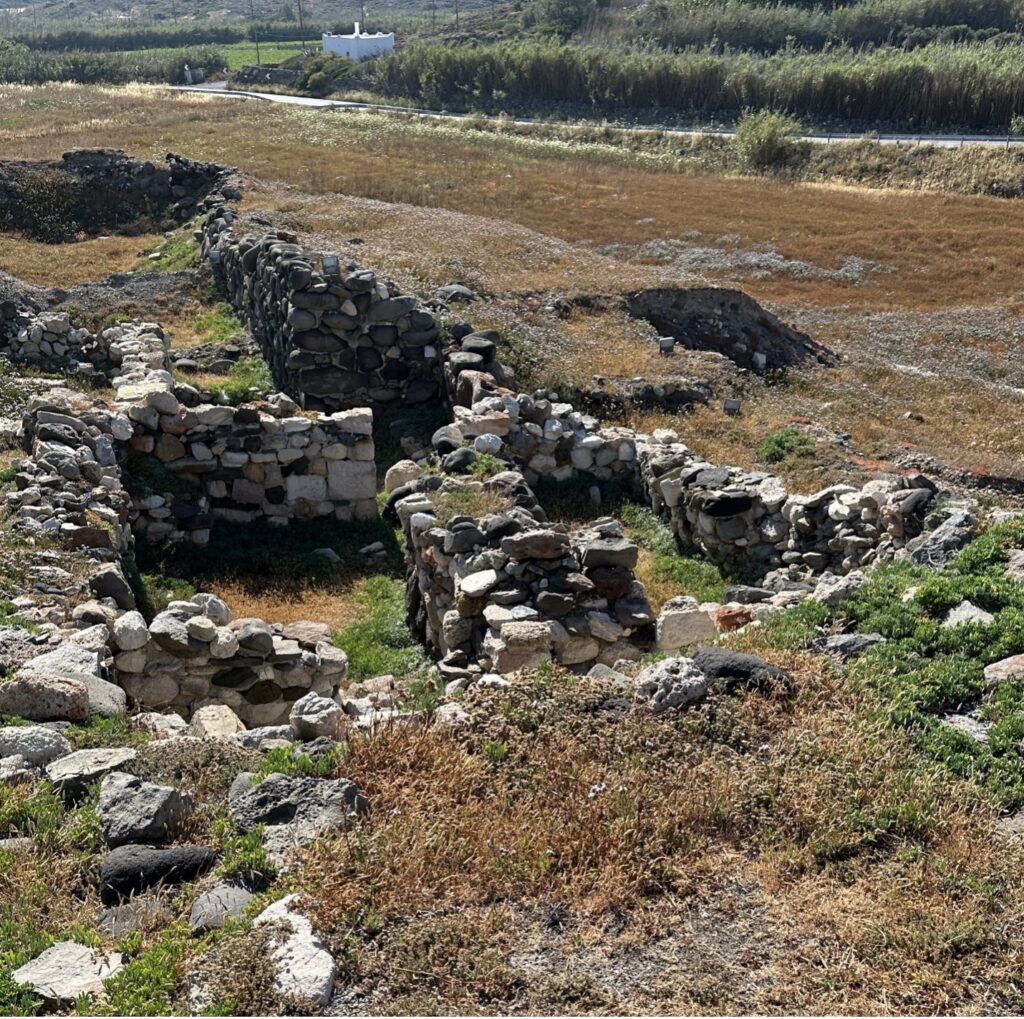
The Phylakopi site was fascinating, empty, magnificent in its setting, and charged with the wonderful perfume of whatever plant it was – I sniffed every kind of flower and weed, but never did find the right one.
The ruins date to around 3300-3500 BC, but like all Cycladic settlements, the place was abandoned around 1100 BC. It’s all built of stone apparently hauled up from the beach: mostly black, rounded volcanic-looking rock with “bubbles,” but still heavy. An interesting feature was that there was no really dressed stone, though some of the round stones had been split or worked on one side to make a fit. I counted four or five other types in addition to the black stones, none looking like the bedrock. Clearly, you can carry in a lot of rocks if you have 22 centuries to do it in!
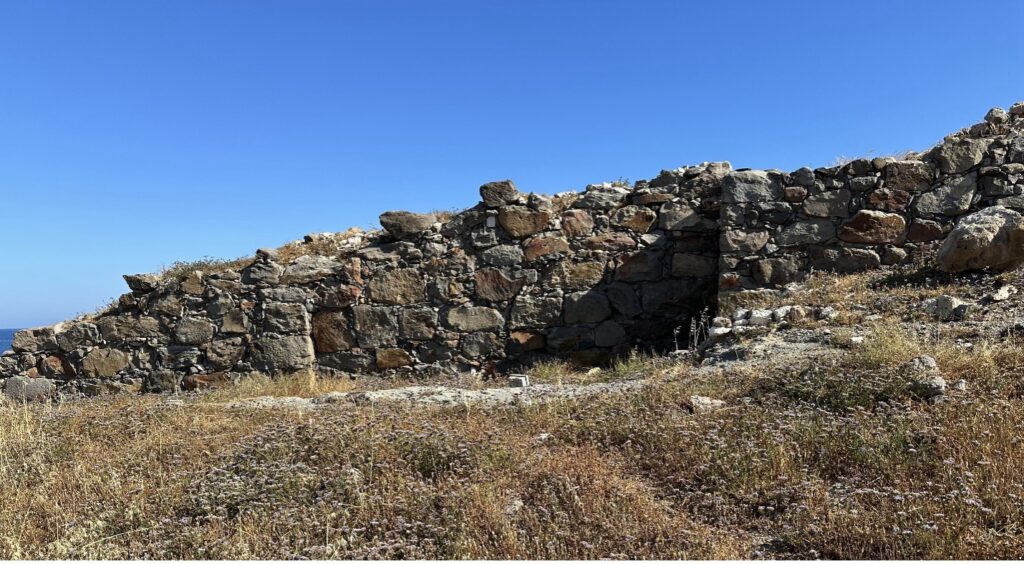
The site, on a small peninsula, lies over two bays – one very small and rocky, probably not usable for much, the other large, protected from most winds by cliffs on the far side and by the peninsula itself. The larger bay would have wound futher around one side of the foot of the hill when the sea was just a bit higher. The “former bay” — probably the port — is a low, flat and green marsh, so there is water there.
During World War II the Germans pulled down the threshold of the main gate, then standing some 12-14 feet high, and built a road to the top of the citadel in order to place a gun. A tribute, at least, to the original inhabitants’ choice of a strategic location, if not to the Nazi respect for history.
I found fresh sneaker tracks on some of the paths around Phylakopi, indicating that perhaps another year everything might be simpler if one just climbed over the fence!
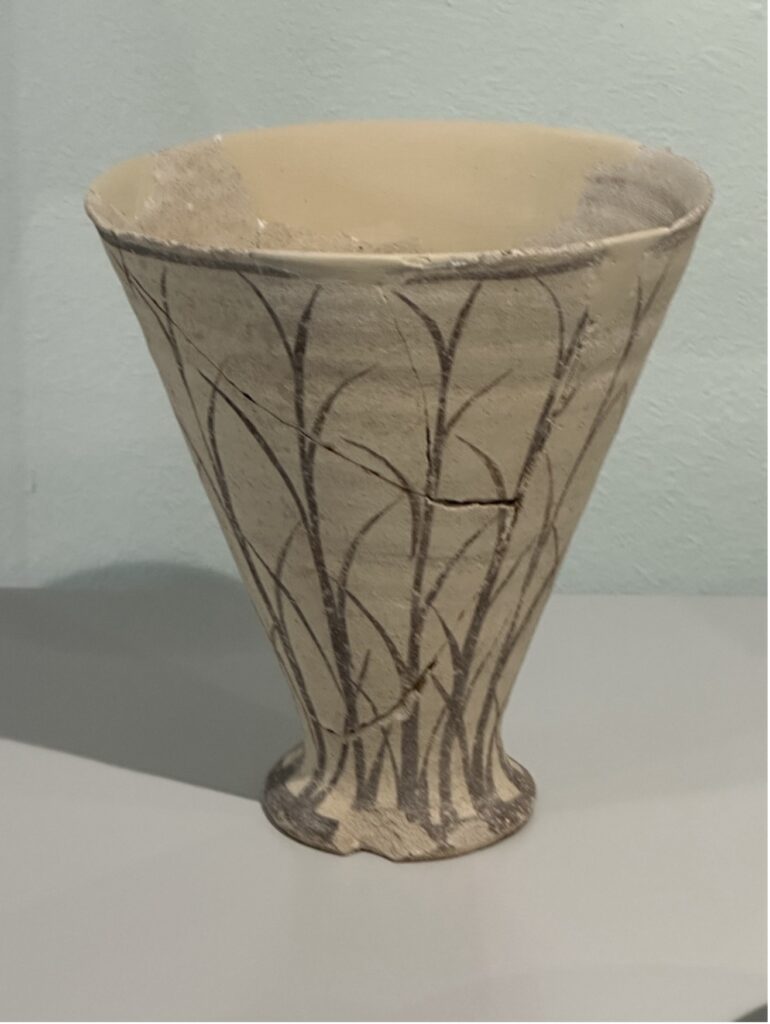
Another attraction on Milos is the Archaeological Museum, high up the hill at Choros, the Old Town. A small collection, but it provides a rich insight into Cycladic civilization as well as of more recent eras. There is a fine copy of the Venus de Milo, aka the Aphrodite of Milos, discovered on Milos in 1820, now resident in the Louvre, dating from the 2nd century BC.
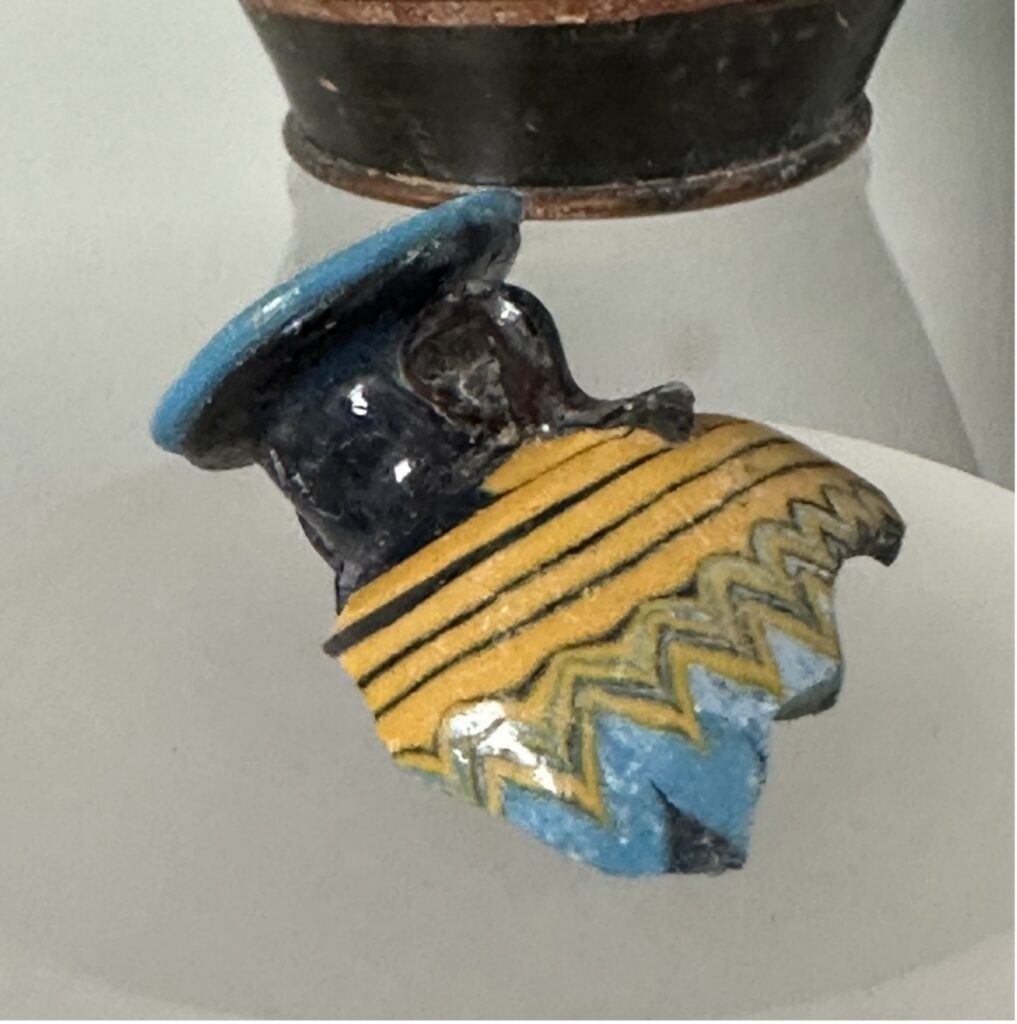
There was one object at the museum that startled me, and still puzzles: a fragment of colored glass, found in an archaic tomb, the only example of glass I have ever seen until we get into the Roman period. The labels in the museum are what we might call “laconic” – or perhaps “telegraphic,” and offered no explanation. Native? Egyptian? An enigma.
Milos offered the one disappointment of the entire trip: the wonderful seafood restaurant I discovered last year, where I returned almost every evening in order to work through the menu (sea urchin on pasta, anyone?), one of the best places I have ever eaten – had devolved into yet another overpriced tourist spot with bad service and a boring menu. Sic transit gloria mundi. Or perhaps “Cosi fan tutte,” very roughly translated as “They all do it” – i.e.: all restaurants go downhill sooner or later. Bah! But Adamantas, the port, offers many other perfectly good places to eat, right down on the waterfront and only a minute’s pleasant walk along the sea wall from the Hotel Milos.
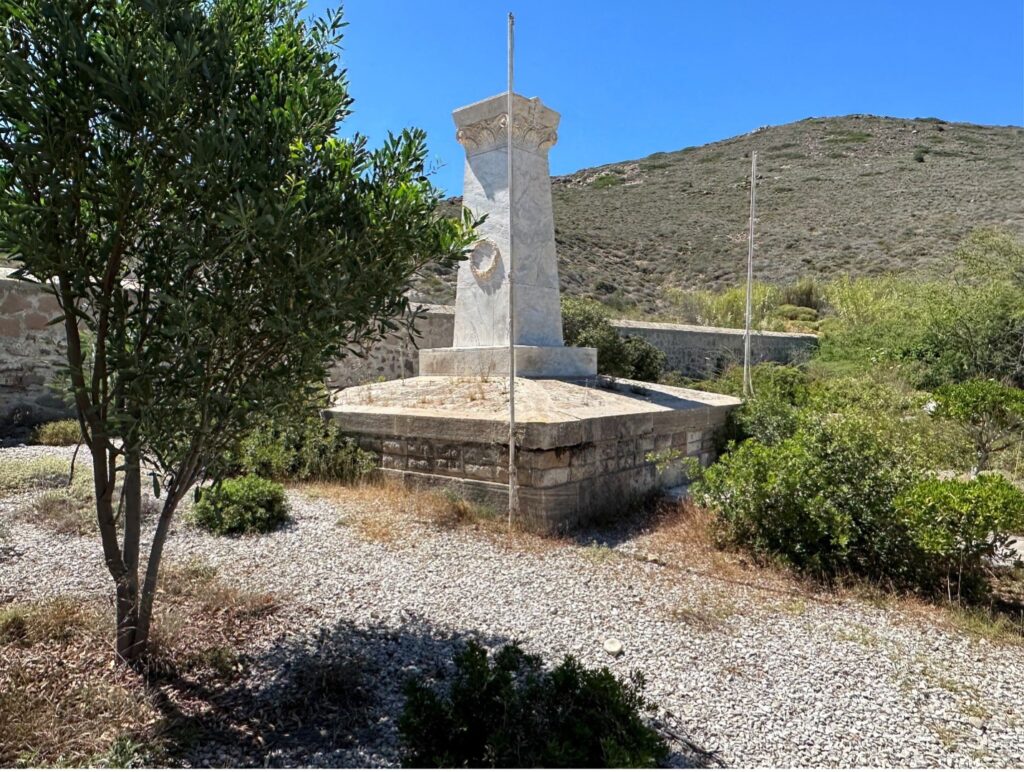
Another delight of Milos, for me at least, is the walk past the ferry dock and along the bay to the French Cemetery, established during the Crimean War when the bay was a major anchorage for the fleets. It is a quiet place now, with a feeling of being almost in a different world from the harbor, though only a half hour’s walk over some rather neglected paths. But it is a place, seldom visited, where you can simply sit, look across the bay, listen to the water gently lapping the beach, and be at peace.
On last days on Milos I had the hotel do some laundry, which I had been doing by hand in the bathroom sink for the last two month – it had been my goal to do the whole trip with minimal baggage in one medium-sized suitcase and a rucksack. But flying home was to be through London with a stop-off to see friends, and I wanted to appear less rumpled. BTW – hand laundry dries fast in the Greek heat and low humidity! (We pause for my one commercial announcement. Go to Amazon and order Soak laundry soap. One cap in the sink, soak for 15 minutes, let dry. Throw away the Dr Bronner’s. This stuff works! I will never travel again without it.
So now it was time to begin the return home, and I caught the afternoon ferry to Piraeus, port of Athens. But it was still Greece: The ferry to Piraeus was an hour late owing to “port traffic,” which seems to be the standard “reason” when the boats are late; certainly, there was no traffic in Milos, nor in the other two ports we stopped in.
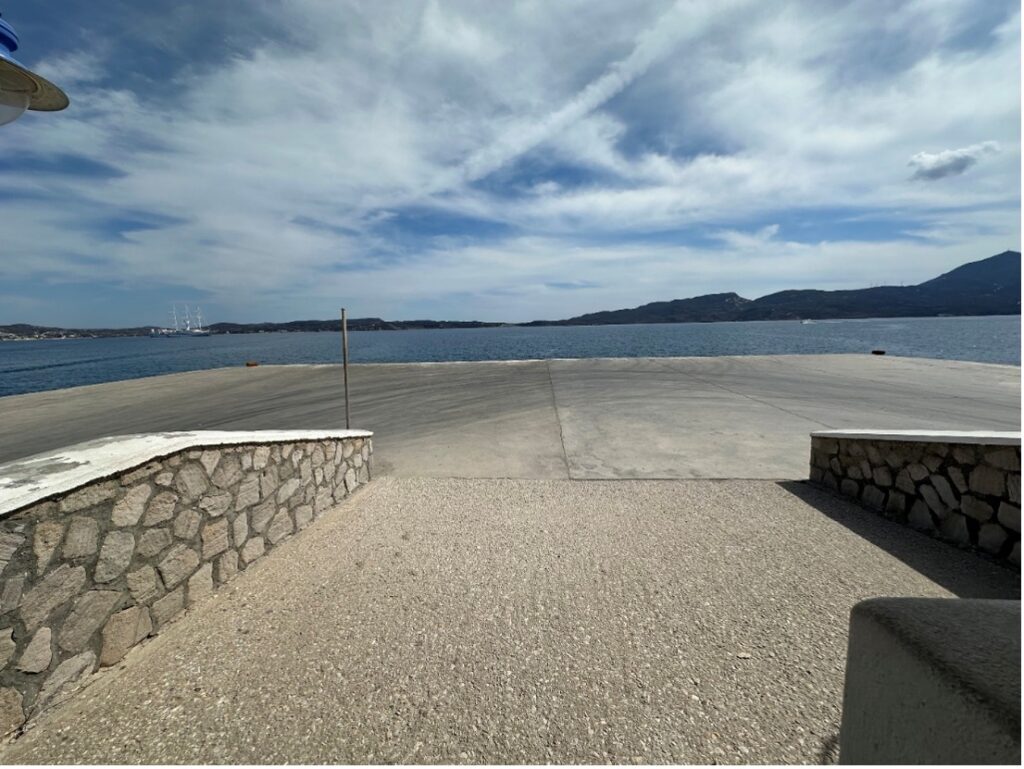
Because of the late departure, we arrived in Piraeus around 9 p.m. Rather than docking at the regular dock, as shown on the ferry lines webpage, about 750 meters from the hotel, we tied up at the farthest dock on the opposite side of the harbor, 2.5 km from the hotel, and: there was a taxi/Uber strike! I set out on foot, towing my suitcase (whoever invented the spinner suitcase deserves a Nobel Prize!) and managed maybe a quarter mile on the usual dreadful and intermittent Greek sidewalks (curbs up to about 16 inches high and few ramps at road crossings) – until St Christopher, or perhaps Hermes, protector of travelers turned up in a taxi in the form of a strike breaker! He got me to the hotel too late for dinner, and I collapsed into bed a bit after 10. (Hermes was also the messenger of the gods, the god of trade, athletes — and of thieves, which may explain the strike-breaking?)
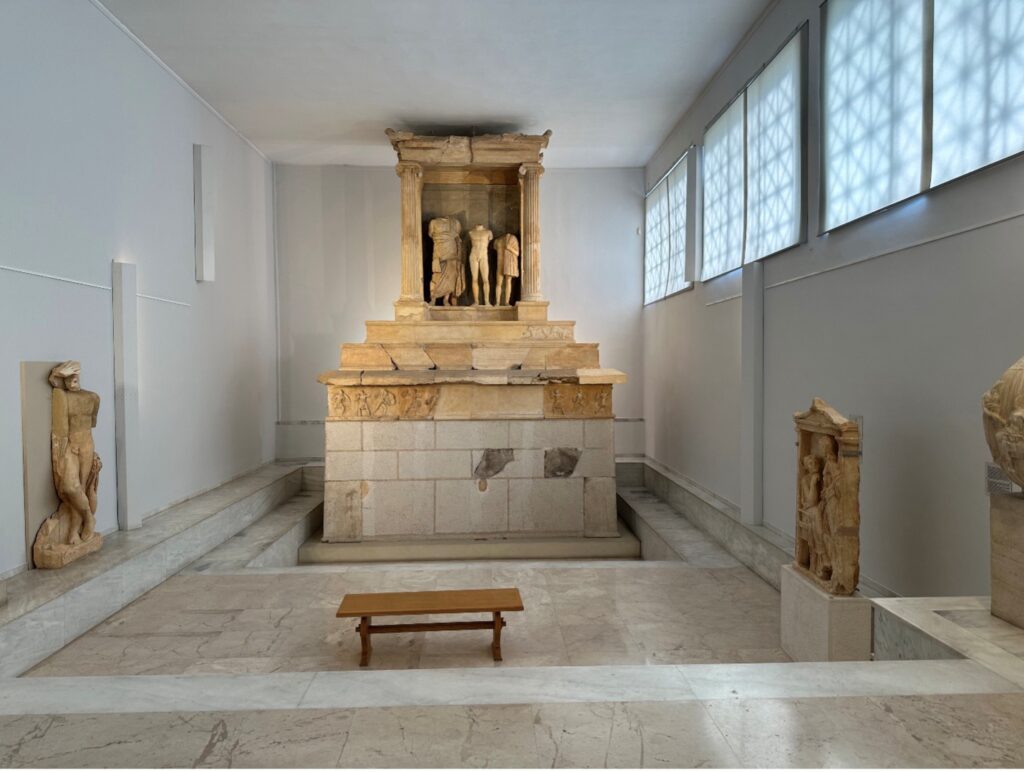
Piraeus is a big, crowded, often shabby city with little to attract the tourist – other than the superlative, if small, Archaeological Museum of Piraeus, which richly rewards a visit. One of its most famous and intriguing exhibits is the Piraeus Apollo, discovered in the harbor in 1959, one of the very few complete bronzes we have from antiquity, bronzes having had the regrettable habit of being melted down to produce newer statues, or later, simply for the metal. Incidentally, a recent article in the Guardian reported that advanced metallurgy has shown that a very large proportion of the tin used to make bronze during the Bronze Age was Cornish in origin; excavations are planned on St Michael’s Mount, which seemingly is the site of early tin mining, a discovery that once again underlines the surprising reach of trade in ancient periods.
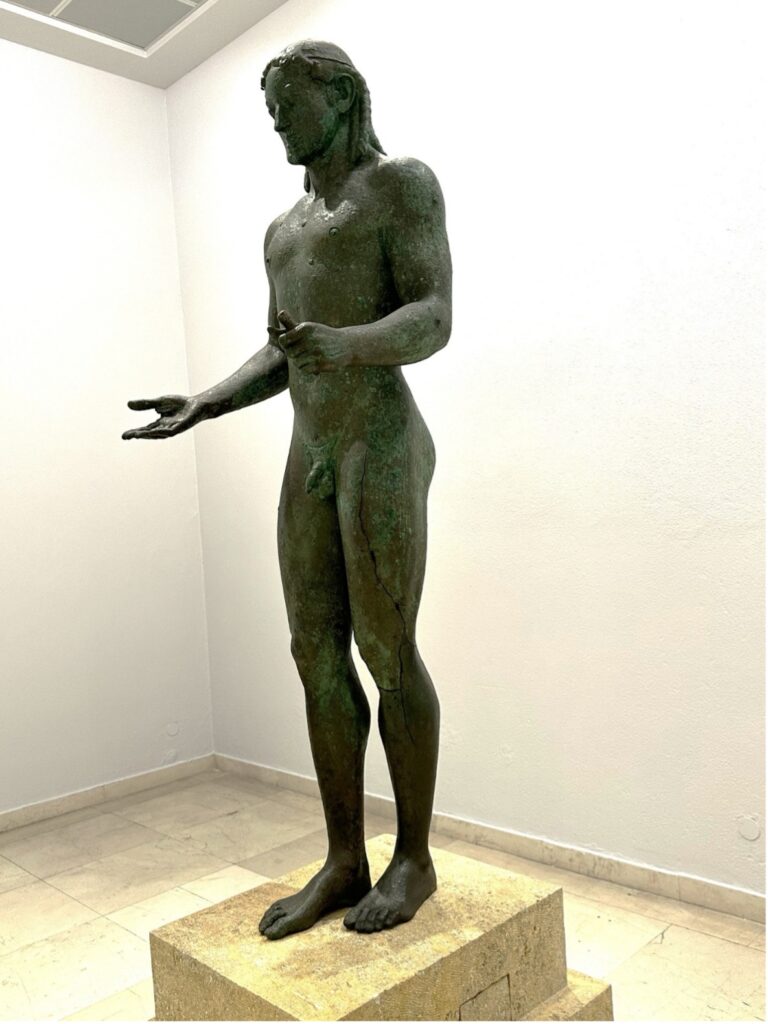
The dating of the statue is controversial. It was originally thought to be from the archaic period, 530-480 BC. It is now suspected to be “of the archaic style,” and to date to the later Hellenistic period, either to lend it the weight and value of age, as part of Athens’ thriving trade in copies for the Roman market, of which there are several undisputed examples in the museum.
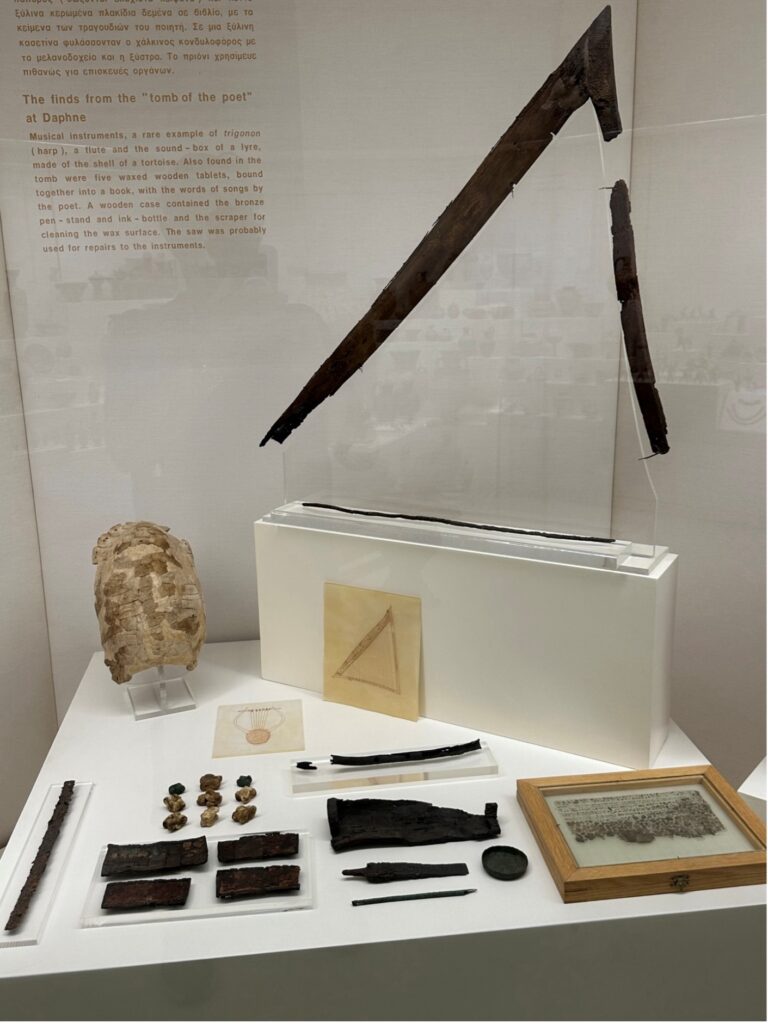
Another fascinating exhibit is from “the grave of the poet,” which includes along with some tools, the frame of a harp, a tortoise shell which was often used as the resonator on stringed instruments, and the lyrics of a poem semi-preserved on the remaining wax of a folding tablet, in the frame in the bottom right-hand corner below:
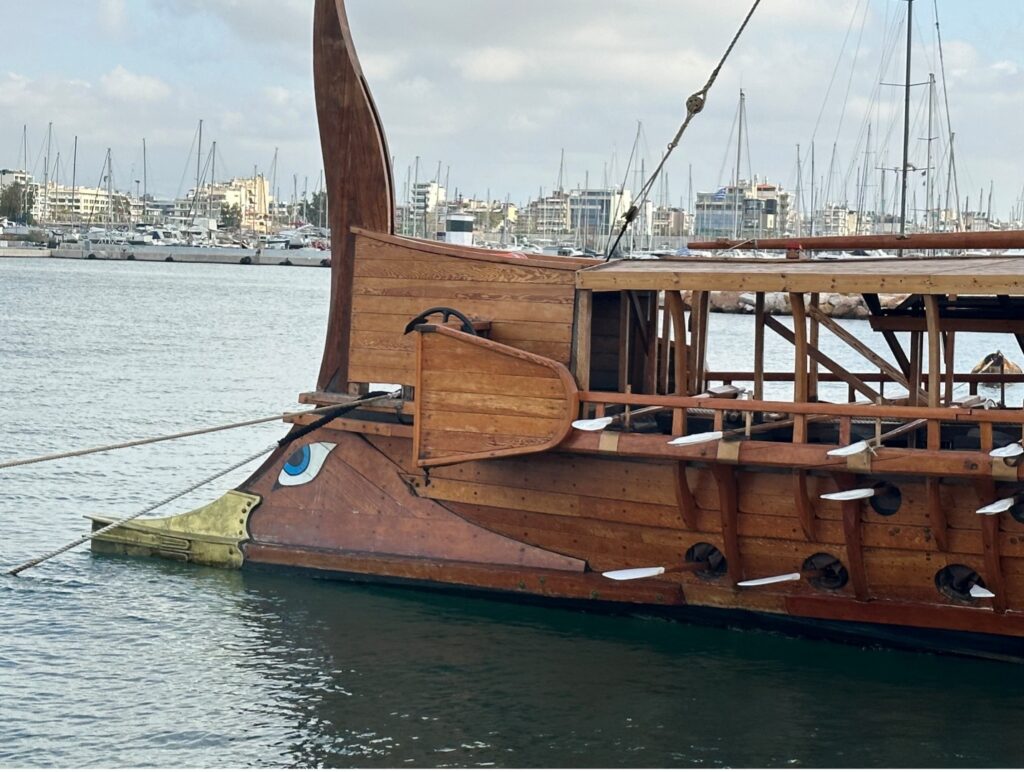
One more thing to see in Piraeus, if you can find it (it moves around) is the trireme Olympias, “constructed from 1985 to 1987 by a shipbuilder in Piraeus. She was built to drawings by the naval architect John Coates which he developed through long discussions with the historian John Morrison following the longest correspondence on any subject in The Times in the early 1980s.” (Wikipedia)
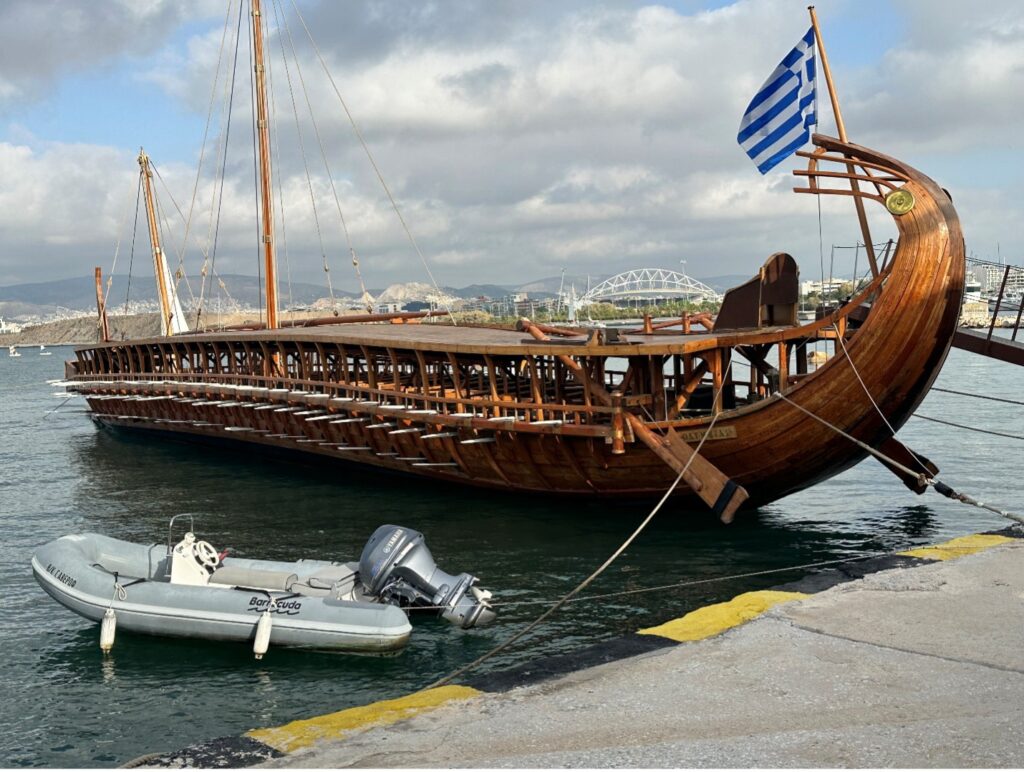
When I went to see the Olympias last year, I asked the sailor in the guard booth whether I might step over the “No Trespassing” rope to get a closer look at the construction of the ship. “Not allowed,” he said, and added, “I am going to go get some coffee,” and vanished. This is Greece! (On the same trip, I asked if I might take a quick photo of an architectural detail in the archaic sculpture hall of the Acropolis Museum, where photography is banned. The guard told me it was strictly forbidden, but she needed to go over to the other side of the room to make sure no elephants got in and knocked things over. I love Greece!)
With that, my glorious two months in Greece came to an end. On the first of June, exactly two months from leaving Edmonds, I caught the British Air flight to Heathrow (running late, as flights out of Athens tend to do) for a few days seeing friends in London, and then home at last.
So – did I “mop up”? Well, yes – and no. There is still Nafplio and the Mycenean ruins to see, and Nestor’s palace at Pylos, the Minoan Bronze Age ruins at Akrotiri on the island of Santorini, Crete and the Minoan palaces there, Ios and perhaps Milos to revisit, hopefully an island or two I have not visited before…
So, with luck and continued health, I can hope that the annual farewell tours will continue.
My friends, we will not go again or ape an ancient rage,
Or stretch the folly of our youth to be the shame of age,
But walk with clearer eyes and ears this path that wandereth,
And see undrugged in evening light the decent inn of death;
For there is good news yet to hear and fine things to be seen,
Before we go to Paradise by way of Kensal Green.
– G.K. Chesterton, The Rolling English Road
Nathaniel Brown taught and coached cross-country running and skiing for 16 years before joining the US Biathlon Team as wax technician, switching to the US Cross-Country team in 1989. He was the first American to take over technical services for a foreign team (Slovenia) and worked also for Germany and Sweden. He coached at three Olympics and 14 World Championships, edited Nordic Update for nine years and Cross-Country Skier for two. He has written three books on skiing and training; the latest was The Complete Guide to Cross-Country Ski Preparation (Mountaineers Books) which has gone through two editions and a Russian translation. He owned and operated Nordic UltraTune, an international freelance ski tuning service, until retirement.


Real first and last names — as well as city of residence — are required for all commenters.
This is so we can verify your identity before approving your comment.
By commenting here you agree to abide by our Code of Conduct. Please read our code at the bottom of this page before commenting.