
Will you chip in to support our nonprofit newsroom with a donation today? Yes, I want to support My Lynnwood News!
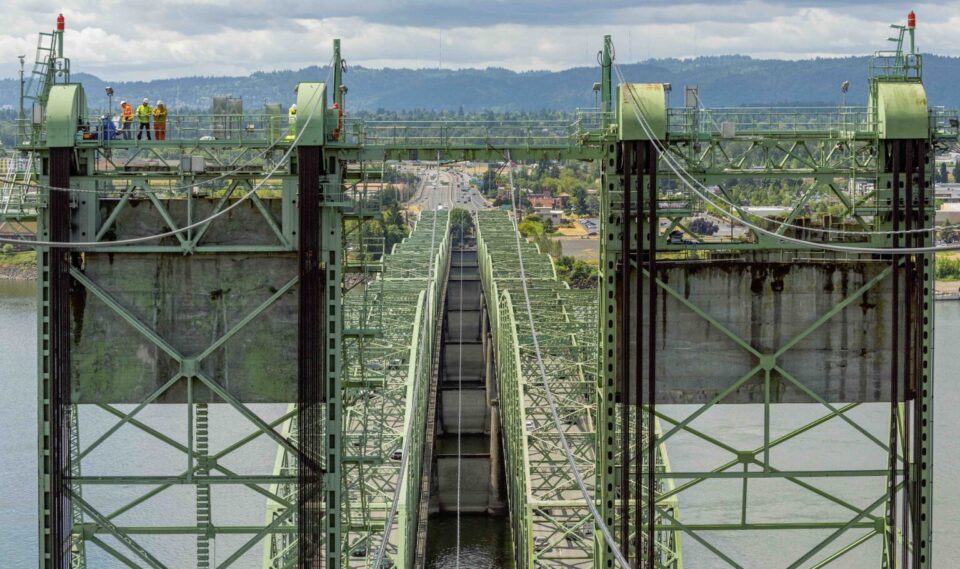
The price tag for a new Interstate 5 bridge across the Columbia River, linking Washington and Oregon, has doubled to $14.4 billion and the timeline to get it built has slipped again.
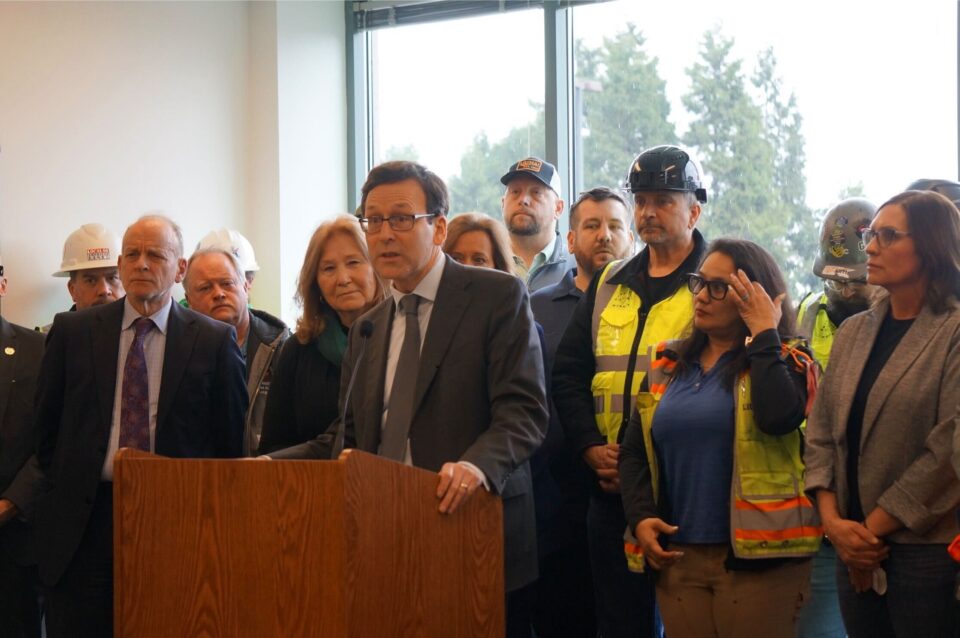
Elements of the massive undertaking will be delayed as the focus, and all available dollars, will be directed at building the new bridge itself, the governors of the two states said. The new estimates showing much higher costs were released Tuesday at a news conference orchestrated by Washington Gov. Bob Ferguson.
“I’m not looking backwards,” Ferguson said. “We’re building this damn bridge. That’s happening.”
The project has been in the works for years, amid worries the current bridge could fail in a major earthquake. In its entirety, the Interstate Bridge Program encompasses a raft of transportation improvements from bus shelters to off-ramps spread throughout a five-mile corridor.
Oregon Gov. Tina Kotek, who was unable to attend Tuesday’s event, said in a statement that by committing available funding to a core set of projects, “we can deliver what Oregonians have been waiting on for decades. We need a new bridge and it’s time to start building it.”
For several years, project planners have estimated the price for a new bridge ranged from $5 billion to $7.5 billion. Staff began recalculating the estimate last year, examining more than 100 risk factors, including inflation and tariffs.
On Tuesday, they rolled out a new range of $13.5 billion to $15.2 billion, with a most likely cost of $14.4 billion.
Ferguson brushed aside that figure, saying the tab for replacing the northbound and southbound spans of the bridge, connecting them to the highway, and extending light rail service to Vancouver, Washington, will cost $7.65 billion. If the bridge is built to accommodate, but not include light rail, the cost estimate drops to $5.9 billion.
Those are the “core” projects the two states can do with the amount of funding secured, Ferguson said.
Washington and Oregon have roughly $5.45 billion already coming from several sources, including federal grants totaling $2.1 billion that were awarded under the Biden administration.
“My job as governor is to make sure that we focus on what we can do right now and what’s most important right now,” he said, adding the states have a “significant cushion for unexpected developments.”
Ferguson said a contract will be issued next year. Cars could be driving across the new span by 2035, roughly two years later than previously announced.
Mixed reactions
Lawmakers, construction industry representatives and leadership from TriMet, Portland’s public transit agency, celebrated the governors’ commitment to the project.
“I’m feeling extraordinarily excited and feeling as if we are really, finally getting to it,” said Oregon Rep. Susan McLain, D-Forest Grove.
Washington state Rep. Andrew Barkis, R-Olympia, called Ferguson’s reframing of the project goals “pretty good political spin.”
“I don’t disagree we need a new bridge,” said Barkis, lead Republican on the House Transportation Committee. But he added, “It seems every major project we do takes too long and costs too much. Ultimately, they’ll come back to the legislatures and ask for billions more for future phases.”
The Democratic chair of the Senate Transportation Committee in the Washington Legislature said he sees the two states staying the course together.
“While this new estimate is a heavy lift, it doesn’t change our mission,” said Sen. Marko Liias, D-Edmonds. “We’re going to prioritize every dollar and make the hard choices necessary to keep this bridge replacement moving forward. It’s about being smart with what we have so we can deliver what the public needs.”
Debating the numbers
Central to the megaproject is the building of new spans over the Columbia River to replace the existing structure, which rests on wooden piles and includes a span that is over a century old.
Ferguson said inclusion of light rail transit between Portland and downtown Vancouver must remain part of the project. He also voiced support for removal of the existing bridge once the new one opens.
Planners are pursuing $1 billion from the Federal Transit Administration’s Capital Investment Program for the light rail portion of the project. It would involve a 1.9-mile extension of light-rail from North Portland to a future station near Evergreen Boulevard in Vancouver. A decision on that funding isn’t expected until the project is further along.
Each state has committed about $1 billion. Tolls — which will be imposed in both directions on the existing bridge starting in 2027 and managed by Washington — are expected to generate a minimum of $1.2 billion. Oregon has a moratorium on any tolls other than the bridge.
Project critics seized on the doubled cost estimate, which they did not find surprising.
Legislators have been saying since last fall that they anticipated the total could reach $10 billion based on rising costs with other projects.
Joe Cortright, a Portland economist and project critic, warned in January that the revised expense could range between $12.2 billion and $17.7 billion based on public records he obtained and shared with reporters.
On Tuesday, he said that once work starts, it won’t end for decades.
“The reality is they’ll never stop with Phase I. Start construction and you’re signing up for $15 billion and 20 years of construction hell,” Cortright said, calling it reckless to build the bridge in phases as money becomes available.
State Rep. John Ley, R-Vancouver, said only the “eternal optimist” would say Washington and Oregon can deliver the desired bridge program as pledged by the governors on Tuesday.
“Based on what’s on paper, you say ‘yes, we can get there’,” he said. “Practical experience says ‘no.’ I would be stunned if they don’t come back to both states for more money. And it will be several billion dollars more.”
Next steps
With a new cost estimate, program administrators must now draw up a plan showing how the multi-year undertaking will be financed. Program leaders have said this plan is due to the federal government by the end of September and is needed to unlock a $1.5 billion capital investment grant secured in 2024.
In addition, the Federal Highway Administration and Federal Transit Administration are expected to publish the final supplemental environmental impact statement for the project sometime this year. Completion of that review is a critical step in moving the project along.
If all the required boxes are checked and approvals obtained as hoped in 2026, construction could start in 2028 and last six to seven years.
Oregon Sen. Khanh Phạm, D-Portland, said she hopes the new cost estimate will be a turning point for state agencies to curb excessive spending.
“It’s imperative that policymakers in both states continue to push back against an oversized, bloated project and demand that the Oregon Department of Transportation propose and deliver a right-sized bridge with a right-sized budget that doesn’t bankrupt our state,” Phạm said.
Oregon Capital Chronicle reporters Mia Maldonado and Alex Baumhardt contributed to this report.
Washington State Standard is part of States Newsroom, a nonprofit news network supported by grants and a coalition of donors as a 501c(3) public charity. Washington State Standard maintains editorial independence. Contact Editor Bill Lucia for questions: info@washingtonstatestandard.com.


Real first and last names — as well as city of residence — are required for all commenters.
This is so we can verify your identity before approving your comment.
By commenting here you agree to abide by our Code of Conduct. Please read our code at the bottom of this page before commenting.